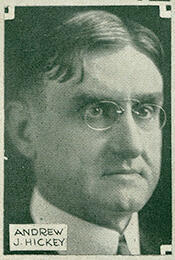
Andrew James Hickey (August 27, 1872 – August 20, 1942) was an American lawyer and Republican politician who served six consecutive terms as a U.S. Representative from Indiana from 1919 to 1931. Over the course of his twelve years in the House of Representatives, he contributed to the legislative process during a significant period in American history, representing the interests of his Indiana constituents through the close of World War I, the 1920s, and the onset of the Great Depression.
Hickey was born in Albion, Orleans County, New York, on August 27, 1872. He was raised in his native city and attended the public schools there, receiving a basic education that prepared him for professional study. He came from a family that would produce more than one public figure; his brother, William J. Hickey, later became a New York politician and judge and outlived him by a decade, underscoring the family’s broader engagement in public service.
After completing his early schooling, Hickey pursued legal studies at Buffalo (New York) Law School. He was admitted to the New York bar in 1896, marking the beginning of his professional career in the law. Seeking opportunity in the growing communities of the Midwest, he moved shortly thereafter to Indiana. In 1897 he commenced the practice of law in La Porte, Indiana, where he established himself as an attorney and entered into the civic and political life of the region that he would later represent in Congress.
Hickey’s legal career in La Porte provided the foundation for his entry into elective office. A member of the Republican Party, he became active in local and state political affairs, building a reputation that led to his selection as a candidate for the U.S. House of Representatives. His professional background as a lawyer informed his approach to legislative work and positioned him to participate effectively in the drafting and consideration of federal laws.
In 1918 Hickey was elected as a Republican to the Sixty-sixth Congress, and he took his seat on March 4, 1919. He was subsequently reelected to the five succeeding Congresses, serving continuously through the Sixty-seventh, Sixty-eighth, Sixty-ninth, Seventieth, and Seventy-first Congresses. His tenure thus extended from March 4, 1919, to March 3, 1931. During these six terms in office, Hickey participated in the democratic process as a member of the House of Representatives and contributed to the legislative deliberations of an era marked by postwar adjustment, economic expansion, and the initial shocks of the Great Depression. Throughout this period he represented the interests of his Indiana constituents within the broader national debates of the time.
Hickey’s congressional service came to an end following the 1930 elections, when he was an unsuccessful candidate for reelection to the Seventy-second Congress. He continued to seek a return to the House, running again in 1934 for the Seventy-fourth Congress and in 1936 for the Seventy-fifth Congress, but he was unsuccessful in both of those campaigns. These defeats reflected the shifting political landscape of the 1930s, as the nation responded to the economic crisis and party alignments changed.
After leaving Congress, Hickey resumed the practice of law, returning to his profession in Indiana. He continued to be identified with La Porte, where he had long maintained his home and legal practice, and remained engaged in his community as a private citizen and attorney. His post-congressional years were spent outside of public office but within the legal field that had first brought him to prominence.
Andrew James Hickey died on August 20, 1942, in Buffalo, New York, while on a motor trip. Although he died in the state of his birth, he was interred in Pine Lake Cemetery in La Porte, Indiana, reflecting the central place that community held in his personal and professional life. His career as a lawyer and six-term U.S. Representative from Indiana left a record of sustained participation in the legislative affairs of the United States during a transformative period in the nation’s history.
Congressional Record