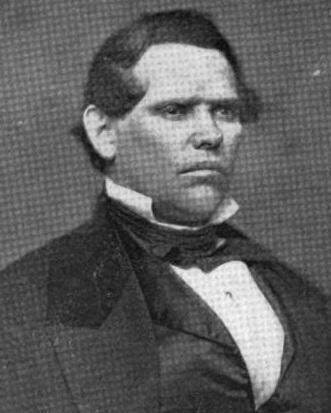
Andrew Jackson Harlan (March 29, 1815 – May 19, 1907) was a U.S. Representative from Indiana and later a member, and speaker, of the Missouri House of Representatives. A cousin of Ohio congressman Aaron Harlan, he was born near Wilmington, Clinton County, Ohio, on March 29, 1815. He attended the local public schools in Ohio and, after deciding to pursue a legal career, read law in the customary manner of the time.
Harlan was admitted to the bar in 1839 and that same year commenced the practice of law in Richmond, Indiana. Also in 1839 he moved to Marion, Grant County, Indiana, where he continued his legal practice and became active in state politics. His early involvement in public affairs led to his appointment as clerk of the Indiana House of Representatives in 1842. He subsequently won election as a member of the Indiana House, serving from 1846 to 1848, and established himself as a Democratic politician of growing influence in the state.
Building on his state legislative experience, Harlan was elected as a Democrat to the Thirty-first Congress, serving as a U.S. Representative from Indiana from March 4, 1849, to March 3, 1851. After a brief interval out of federal office, he returned to Congress when he was elected to the Thirty-third Congress, serving from March 4, 1853, to March 3, 1855. During this second term he was chairman of the Committee on Mileage, a standing committee of the House of Representatives responsible for matters relating to the travel allowances of members. His congressional career coincided with the intensifying national debate over slavery and territorial expansion, and his actions in that context would significantly affect his party affiliation.
In 1854, at a Democratic congressional convention in Marion, Indiana, Harlan was publicly read out of the Democratic Party because he had voted against the repeal of the Missouri Compromise, a key provision that had long regulated the expansion of slavery into new territories. His refusal to support the repeal placed him at odds with the dominant faction of his party. That same year he declined a nomination from the emerging People’s Party for a seat in the Thirty-fourth Congress, signaling a period of political transition. In the aftermath of these events, he aligned himself with the newly formed Republican Party, which opposed the extension of slavery into the territories.
Harlan moved west in 1861 to the Dakota Territory, where he continued his public service in a frontier setting. He was elected a member of the Territorial House of Representatives in 1861 and served as speaker of that body. His tenure in Dakota was cut short in September 1862, when he was driven from the Territory by hostilities involving Native American groups. He then settled in Savannah, Andrew County, Missouri, where he resumed the practice of law and quickly reentered political life. From 1864 to 1868 he served as a member of the Missouri House of Representatives, acting as speaker for the last two years of his term, thus holding leadership positions in both a territorial legislature and a state legislature during his career.
In 1885 Harlan moved again, this time to Wakeeney (often spelled WaKeeney), Trego County, Kansas, where he continued to practice law. His long experience in public affairs led to a federal appointment when President Benjamin Harrison named him postmaster of Wakeeney. He held that position from 1890 to 1894, overseeing postal operations in the growing western community. After completing his service as postmaster, he returned in 1894 to Savannah, Missouri, a town that had become his principal home in his later years.
Andrew Jackson Harlan died in Savannah, Missouri, on May 19, 1907, at the age of ninety-two. He was interred in Savannah Cemetery. His long life spanned the antebellum, Civil War, and postwar eras, and his career encompassed legal practice, service in state, territorial, and federal legislatures, and local federal office, reflecting the mobility and political realignments characteristic of nineteenth-century American public life.
Congressional Record