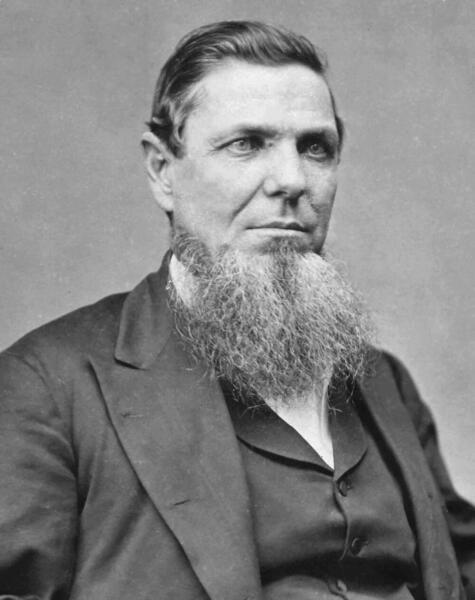
Andrew Jackson Hamilton (January 28, 1815 – April 11, 1875) was an American politician and lawyer who served as the 11th governor of Texas from 1865 to 1866 during Reconstruction. As a member of the Independent Party representing Texas, he contributed to the legislative process during one term in the United States Congress, serving during a significant period in American history and representing the interests of his constituents in the midst of mounting sectional conflict.
Hamilton was born in Huntsville, Alabama, on January 28, 1815. He was raised in the antebellum South and received his early education in Alabama. He studied law there, attended law school, and was admitted to the bar in Talladega, Alabama. In late 1846 he moved to the Republic-era frontier of Texas to join his older brother, Morgan Hamilton, and opened a law practice in La Grange, Texas. His legal work in La Grange established his reputation and, after three years, he relocated in 1849 to Austin, Texas, where he intended to build a broader political career in the new state.
Hamilton’s rise in Texas public life was rapid. In 1849 Texas Governor Peter H. Bell appointed him acting state attorney general, a position that gave him statewide prominence. The following year, in 1850, he was elected as a Democrat to the Texas House of Representatives from Travis County. He served a single term in the state legislature, leaving office in 1853. During this period he joined the so‑called “Opposition Clique,” a faction of Southern Democrats who opposed secession and the reopening of the African slave trade, marking him early as a Unionist within a pro-slavery and increasingly secessionist political environment.
In 1858 Hamilton was elected to the United States House of Representatives as an Independent Democrat from the western district of Texas. As a member of the Independent Party representing Texas, he served one term in Congress, participating in the democratic process at a time of deepening national crisis. During his service he sat on a House committee formed late in 1860 to seek a resolution to the growing sectional feud between North and South. Choosing not to run for re-election in 1860, he returned to Texas and, in 1861, won a special election to the Texas State Senate. His outspoken pro-Union views, however, provoked intense hostility, and threats against his life forced him to resign his Senate seat. In July 1862 he fled Texas for Mexico to escape Confederate persecution.
Throughout the American Civil War, Hamilton remained firmly aligned with the Union. After leaving Texas, he traveled through the Northeast, delivering speeches in New York, Boston, and other Northern cities in support of the Union cause and denouncing what he termed the “slave power” of the South. These activities earned him admiration and a reputation as a hero in much of the North, even as many in his home state regarded him as a traitor. In late 1862 President Abraham Lincoln appointed him Military Governor of Texas with the rank of brigadier general of volunteers. Because Union forces failed in their 1863 attempt to secure South Texas, Hamilton’s post was largely nominal, and he spent the remainder of the war in New Orleans, holding an office that carried little practical authority over his home state.
With the collapse of the Confederacy, Hamilton returned to a central role in Texas politics. On June 17, 1865, President Andrew Johnson named him provisional civilian governor of Texas. He served as the 11th governor of Texas for approximately fourteen months during the early stages of Reconstruction, from 1865 to 1866. His administration coincided with the national ratification of the Thirteenth Amendment, which abolished slavery and granted economic freedom to newly freed slaves, although Texas itself did not ratify the amendment until 1870. As governor, Hamilton confronted a host of postwar challenges, including Indian incursions on the frontier, widespread lawlessness, and disordered state finances in the aftermath of the Civil War. When the Texas Constitutional Convention of 1866 failed to adopt many of his proposed reforms, he broke with President Johnson’s lenient Reconstruction program and aligned himself with the Radical Republicans in Congress. He publicly advocated black suffrage and, in September 1866, helped organize the Southern Loyalists’ Convention in Philadelphia, where he sharply criticized Johnson’s policies.
Hamilton’s political trajectory during Reconstruction continued to evolve. In 1867 he resigned as governor and briefly served as a bankruptcy judge in New Orleans. Later that year he accepted appointment as a justice of the Texas Supreme Court, further extending his influence on the state’s legal and political reconstruction. He sought to return to the governorship in the 1869 election but was defeated by Edmund J. Davis. After leaving office and electoral politics, Hamilton formally affiliated with the regular Republican Party. He served as a delegate to the Texas Constitutional Convention of 1868–69 and sat on the Republican National Executive Committee, participating in the broader redefinition of party and constitutional policy in the postwar era. During this later phase of his career he reversed his earlier stance on black suffrage and withdrew his support for it, a shift that reflected both his personal evolution and the complex, often contentious politics of Reconstruction Texas. In 1871 he emerged as a leading critic of state fiscal policy as head of the Tax-Payers’ Convention, an organization that opposed what many Texans viewed as excessive taxation and government spending under the Reconstruction regime.
Andrew Jackson Hamilton died of tuberculosis in Austin, Texas, on April 11, 1875. He was buried in Oakwood Cemetery in Austin, closing the life of a prominent, controversial Unionist and Reconstruction-era leader whose career spanned the tumultuous decades before, during, and after the Civil War.
Congressional Record