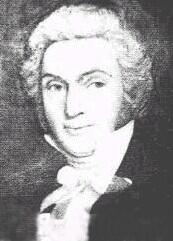
Andrew Beirne (1771 – March 16, 1845) was an Irish immigrant who became a merchant, militia officer, and influential politician in western Virginia, representing Monroe County in both houses of the Virginia General Assembly, the United States House of Representatives, and the Virginia Constitutional Convention of 1829–1830. As a member of the Democratic Party representing Virginia, he served two terms in Congress during a significant period in American history, participating in the democratic process and representing the interests of his constituents.
Beirne was born in 1771 in Dangan, County Roscommon, Ireland, to Andrew Beirne, hereditary chieftain of Dangan, and Mary Plunkett Beirne, daughter of Edward Plunkett, 12th Baron Dunsany. He was the youngest of their five sons and one daughter. Raised in a family of local prominence and Anglo-Irish connections, he received a classical education, possibly with an eye toward preparation for the priesthood, and graduated from Trinity College in Dublin. This formal education provided him with the grounding in literature, rhetoric, and philosophy that later supported his mercantile and political careers.
In 1793 Beirne immigrated to the United States and initially settled in Philadelphia, Pennsylvania. Bringing with him savings of approximately $150, he invested in a business venture that soon failed, forcing him to begin again as a peddler. Around 1795 he moved south and opened a store in Greenbrier County, Virginia, on the farm of Edward Keenan, a fellow Irish immigrant. In Virginia he dropped the “O” from his surname, adopting the spelling “Beirne.” He married Keenan’s daughter, Ellen Keenan, thereby solidifying his ties to the local Irish community. The couple had ten children, of whom five sons and four daughters survived to adulthood. About this time two of Beirne’s brothers also emigrated to the United States, and the three formed a mercantile partnership that transported merchandise from Philadelphia to Virginia and accepted payment in ginseng, pelts, cattle, and other commodities.
Beirne’s business interests expanded as the region developed. After the Virginia General Assembly created Monroe County from part of Greenbrier County, he moved his store to the new county seat at Union. His enterprise prospered, and he opened additional stores elsewhere in Virginia and in the South. Over time he acquired seventy‑two tracts of land, some likely taken in settlement of customers’ debts, and established a 2,200‑acre plantation on prime land north of Union, which he named “Walnut Grove.” This estate became both his family residence and the center of his agricultural and commercial operations and would later be recognized for its historical significance when “Walnut Grove” was listed on the National Register of Historic Places in 1977.
Beirne’s prominence as a merchant and landowner led naturally into public service. Initially aligned with the Jeffersonian Republican political party, he was elected by Monroe County voters as their part‑time representative in the Virginia House of Delegates in 1806 and was subsequently re‑elected. Alongside his legislative service, he became a captain in the county militia. During the War of 1812 his rifle company was ordered to Norfolk, Virginia, to help protect the port and naval shipyard, although the unit ultimately saw no combat. His combined experience in commerce, local government, and the militia enhanced his standing as a leader in western Virginia.
In the late 1820s Beirne played a role in the reshaping of Virginia’s fundamental law. He was elected as a delegate to the Virginia Constitutional Convention of 1829–1830, a gathering that addressed long‑standing issues of representation and governance between the eastern and western sections of the state. Following this service, he continued his state legislative career as a member of the Virginia State Senate from 1831 to 1836, representing the interests of Monroe County and the surrounding region during a period of political realignment and economic change.
Beirne advanced to national office in 1837, when he was elected as a Democrat to the Twenty‑fifth Congress, and he was re‑elected to the Twenty‑sixth Congress, serving from March 4, 1837, to March 3, 1841. His two terms in the U.S. House of Representatives coincided with the presidencies of Martin Van Buren and the early months of William Henry Harrison’s administration, a time marked by the Panic of 1837 and intense debate over banking, internal improvements, and federal economic policy. As a Democratic Party representative from Virginia, he participated in the legislative process on these and other national issues while continuing to represent the concerns of his largely rural constituency in western Virginia. He declined to be a candidate for reelection to the Twenty‑seventh Congress in 1840 and returned to his business and agricultural pursuits.
In his later years Beirne remained a prominent figure in Monroe County, overseeing his mercantile interests and the “Walnut Grove” plantation. His family continued to be intertwined with regional and southern economic life. His son, Oliver Beirne, inherited The Houmas slave plantation and nine additional plantations from John Burnside, a man whom Andrew Beirne had helped to become a successful businessman and who was regarded as part of the family; a local legend held that Burnside had been found as an infant by Andrew Beirne and raised as a son. Burnside is buried with the Beirne family at Green Hill Cemetery in Union, reflecting the closeness of these ties.
Andrew Beirne died on March 16, 1845, while on a visit to Gainesville, Sumter County, Alabama. His body was returned to Virginia, and he was interred in the family burying ground at Union in Monroe County. His life traced a trajectory from Irish chieftain’s son and classically educated emigrant to frontier merchant, militia officer, state legislator, constitutional convention delegate, and member of the United States House of Representatives, leaving a lasting imprint on the political and economic development of western Virginia.
Congressional Record