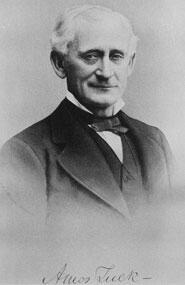
Amos Tuck (August 2, 1810 – December 11, 1879) was an American attorney, legislator, and political organizer in New Hampshire, widely regarded as a founder of the Republican Party in that state. He was born in Parsonsfield, York County, Maine, on August 2, 1810, the son of John Tuck, a sixth-generation descendant of Robert Tuck, one of the founders of Hampton, New Hampshire, in 1638. In his youth he came to Hampton, New Hampshire, where his family’s long-standing presence and civic involvement helped shape his later political commitments and public career.
Tuck attended Effingham Academy and Hampton Academy in New Hampshire, institutions that prepared him for higher education and an early career in teaching. He graduated from Dartmouth College in Hanover, New Hampshire, in 1835. Shortly after graduation he returned to Hampton Academy, where he served as headmaster from 1836 to 1838 at the school founded by his ancestors. During this period he also began to study law. An early supporter and donor to the Free Will Baptists’ Parsonfield Seminary in Maine, Tuck demonstrated from a young age a strong interest in education and religiously inspired reform. He was later elected a trustee of Dartmouth College, maintaining a close relationship with his alma mater throughout his life.
In 1838 Tuck was admitted to the bar and commenced the practice of law in Exeter, New Hampshire, a community in which he would become a leading citizen for roughly four decades. From about 1838 until his death in 1879 he played an important part in Exeter’s civic and political life, building a successful legal practice and participating in local affairs. His prominence in Exeter and in state politics grew steadily during the 1840s, as he became known for his anti-slavery views and his willingness to challenge established party structures.
Tuck’s formal political career began in the New Hampshire House of Representatives, to which he was elected in 1842 as a member of the Democratic Party. He soon broke with pro-slavery Democratic leaders, and in 1844 he was formally cast out of the party because of his opposition to the extension of slavery. Undeterred, he remained active in politics. In 1845 he called a convention to form an independent movement in support of anti-slavery congressional candidate John P. Hale. Tuck later described this convention as “respectable in numbers and unparalleled in spirit,” and historians have identified it as “the nucleus of the Republican Party.” In the months following the convention he worked tenaciously to build the new anti-slavery coalition, and his efforts contributed significantly to Hale’s successful election to the United States Senate in 1846.
Tuck himself sought national office as an independent and anti-slavery candidate. He ran for Congress and was elected as an Independent to the Thirtieth Congress. He subsequently ran as a Free-Soil candidate to the Thirty-first Congress and as a Whig to the Thirty-second Congress, serving three consecutive terms in the U.S. House of Representatives from March 4, 1847, to March 3, 1853. As a member of the Whig Party representing New Hampshire, he contributed to the legislative process during this significant period in American history, participating in the democratic process and representing the interests of his constituents at a time of intensifying national conflict over slavery and sectionalism. After his three terms in Congress, he returned to Exeter in 1853 and began working to unite the many minor political factions then active in New Hampshire.
On October 12, 1853, Tuck organized a secret meeting of anti-slavery men at Major Blake’s Hotel in Exeter. At this gathering, later commemorated by a tablet affixed to the Squamscott House in Exeter, he may have suggested the formation of a party to be called “Republicans.” Although no formal party emerged from this meeting and the term “Republican party” had been widely used in New Hampshire politics since the 1790s, the participants went on to campaign for various anti-slavery and reform parties in the 1854 state elections. Two years later, in 1856, Tuck helped form the state Republican Party in New Hampshire and became recognized as one of its founders. He served as a delegate to the Republican National Conventions of 1856 and 1860 and was a personal friend of Abraham Lincoln, the poet John Greenleaf Whittier, and other prominent figures of his time. Tuck played a role in helping Lincoln secure the Republican presidential nomination in 1860. In 1861 he was appointed a delegate to the peace convention held in Washington, D.C., an eleventh-hour effort by leading citizens from several states to devise means to prevent the impending Civil War.
With the outbreak of the Civil War, Tuck accepted a federal appointment outside elective office. From 1861 to 1865 he was commissioned as a naval officer of the port of Boston, a customs position that involved oversight of maritime trade and revenue collection during the conflict. After the war he returned to Exeter, resumed the practice of law, and became active in railroad building. His investments and leadership in railroad enterprises brought him considerable success and wealth, further enhancing his standing in New Hampshire’s business and civic life. Throughout these later years he continued to be identified with Republican politics and with the anti-slavery and Union causes that had defined his earlier public career.
Tuck married Davida Nudd, and the couple had three surviving children. Their daughter Abigail was born in 1835; another daughter, Ellen Tuck, born in 1838, married Francis Ormond French, who became president of the Manhattan Trust Company; and their son, Edward Tuck, was born on August 25, 1842. Through Ellen’s marriage, the family became connected to prominent financial and social circles; Ellen’s daughter, also named Ellen Tuck French, married Alfred Gwynne Vanderbilt in 1901. Edward Tuck graduated from Dartmouth College and went on to make a substantial fortune in banking, railroads, and international trade, eventually serving as vice-consul to France. He became a major benefactor of Dartmouth College and of New Hampshire institutions. In his father’s honor he financed and founded the Amos Tuck School of Business Administration at Dartmouth College, which bears Amos Tuck’s name, and he funded the construction of the New Hampshire Historical Society’s granite building in Concord. Family and political descendants later founded the “Amos Tuck Society” to promote and preserve the history of his contributions to the Republican Party and to New Hampshire political life.
Amos Tuck died in Exeter, New Hampshire, on December 11, 1879. He was interred in Exeter Cemetery. His legacy endures in the institutions he supported, in the Republican Party he helped organize in New Hampshire, and in the continuing recognition of his role in the anti-slavery movement and mid-nineteenth-century American politics, including his association with Abraham Lincoln’s rise within the Republican Party.
Congressional Record