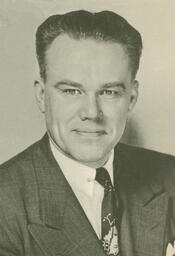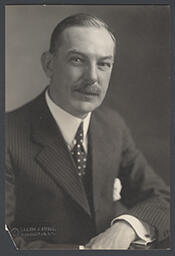
Amos Henry Radcliffe (January 16, 1870 – December 29, 1950) was an American Republican politician who represented New Jersey’s 7th congressional district in the United States House of Representatives, serving two terms from March 4, 1919, to March 3, 1923. His congressional service took place during a significant period in American history, immediately following World War I, when the nation was addressing postwar economic adjustments, veterans’ issues, and evolving domestic and foreign policies.
Radcliffe was born in Paterson, Passaic County, New Jersey, on January 16, 1870. He was educated in the Paterson public schools and later attended and graduated from the New York Trade School, where he received technical training that prepared him for a career in the metalworking and construction trades. From 1888 to 1893 he served as a sergeant in the New Jersey National Guard, gaining early experience in leadership and public service.
Following his education and military service, Radcliffe became a blacksmith and ornamental and structural ironworker. In 1896 he became associated with his father’s firm, James Radcliffe & Sons Co., a structural iron manufacturing company based in Paterson. Demonstrating business acumen and technical expertise, he advanced within the company and, in 1907, was made secretary of James Radcliffe & Sons Co. His involvement in this family enterprise provided him with a foundation in industry and commerce that would inform his later public career.
Radcliffe entered public life in the early twentieth century. He was elected as a member of the New Jersey General Assembly, serving from 1907 to 1912. During this period he also became active in party affairs, serving as a delegate to the Republican State conventions in 1910, 1911, and 1912. He continued to build his public profile at the county level, serving as sheriff of Passaic County from 1912 to 1915. In addition, he was appointed fish and game commissioner for New Jersey, holding that position from 1914 to 1919, a role that involved oversight of conservation and wildlife regulation. Radcliffe further advanced in municipal politics as Mayor of Paterson, New Jersey, serving from 1916 to 1919, a tenure that coincided with the World War I era and its local economic and social impacts.
In 1918 Radcliffe was elected as a Republican to the Sixty-sixth Congress and was reelected to the Sixty-seventh Congress, representing New Jersey’s 7th congressional district. He served in the U.S. House of Representatives from March 4, 1919, to March 3, 1923. As a member of the House of Representatives, he participated in the democratic process and contributed to the legislative work of Congress during a time marked by postwar reconstruction, debates over Prohibition and women’s suffrage implementation, and shifting national priorities. He represented the interests of his New Jersey constituents in this changing environment. Radcliffe was an unsuccessful candidate for reelection in 1922 to the Sixty-eighth Congress, ending his formal congressional career after two terms.
After leaving Congress, Radcliffe resumed active involvement in the family business, Radcliffe & Sons Company, remaining engaged in the structural iron industry. He continued to rise in the firm and was serving as treasurer of the company at the time of his death. Beyond his industrial pursuits, he played a prominent role in local finance as the founder and a former president of the Franklin Trust Company of Paterson, where he also served as chairman of the board, reflecting his influence in the city’s commercial and financial life. In 1925 he further extended his public service when he became a member of the Board of Standards and Appeals in Paterson, contributing to municipal regulatory and planning decisions.
Radcliffe spent his later years in New Jersey, maintaining his ties to Paterson and Passaic County through both business and civic activities. He died in Balesville, New Jersey, on December 29, 1950. He was interred in Cedar Lawn Cemetery in Paterson, New Jersey, bringing to a close a career that spanned local, county, state, and national public service, as well as significant involvement in the industrial and financial development of his home city.
Congressional Record