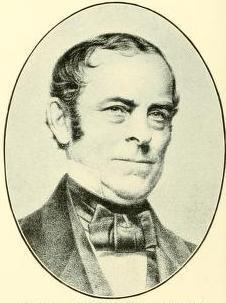
Amos Phelps Granger (June 3, 1789 – August 20, 1866) was a U.S. Representative from New York and a captain in the War of 1812, as well as a cousin of fellow Representative Francis Granger. He was born in Suffield, Hartford County, Connecticut, on June 3, 1789, the youngest of four children of Dr. Amos Granger (1748–1811) and Ann Phelps (1753–1806). His father was a prominent physician who served in the Connecticut Legislature from 1788 to 1791 and had earlier served in the militia alongside General Horatio Gates during the American Revolutionary War. Through his uncle Gideon Granger, the longest-serving United States Postmaster General under Presidents Thomas Jefferson and James Madison, he was first cousin to Francis Granger. Amos Phelps Granger attended the public schools in his youth, receiving a basic formal education typical of the period.
In 1811, Granger moved from Connecticut to Manlius, Onondaga County, New York, where he soon became a leading local figure. He served as president of the town for several years, reflecting his early engagement in civic affairs. During the War of 1812 he served as a captain, seeing duty at Sackets Harbor and along the Canada–United States border, where he contributed to the defense of the northern frontier. On December 21, 1813, he married Charlotte Hickox (1790–1882), one of twelve children of Benjamin Hickox. The couple had no children.
Granger relocated to the growing community of Syracuse, New York, in 1820 and became involved in a variety of business enterprises as the region developed economically and commercially. He was elected a trustee of the village (later city) of Syracuse and served in that capacity from 1825 to 1830. During this period he gained wider public visibility, notably delivering the address of welcome to General Lafayette when the Revolutionary War hero visited Syracuse in 1825. His prominence in local affairs and business laid the groundwork for his later political career at the state and national levels.
By the early 1850s, Granger had aligned himself with the Whig Party and its successors in the turbulent realignment that preceded the Civil War. He served as a delegate to the Whig National Convention in 1852, participating in national deliberations at a time when the party was fracturing over issues including slavery and sectional tensions. As the Whig Party declined, he became associated with the emerging Opposition Party and then with the Republican Party, reflecting the broader transition in Northern politics.
Granger was elected as an Opposition Party candidate to the Thirty-fourth Congress and was reelected as a Republican to the Thirty-fifth Congress, serving from March 4, 1855, to March 3, 1859. As a member of the Republican Party representing New York during his second term, he contributed to the legislative process during a significant period in American history, participating in the democratic process and representing the interests of his constituents in the years immediately preceding the Civil War. After two terms in office, he was not a candidate for renomination in 1858 and retired from active business pursuits, withdrawing from national political life.
In his later years, Granger’s health declined. Around 1860 he suffered a paralytic stroke, which left him largely incapacitated. He spent his remaining years in Syracuse, where he had long been a prominent resident. Amos Phelps Granger died in Syracuse, New York, on August 20, 1866, after a bout of dysentery. He was interred in Oakwood Cemetery in Syracuse.
Congressional Record