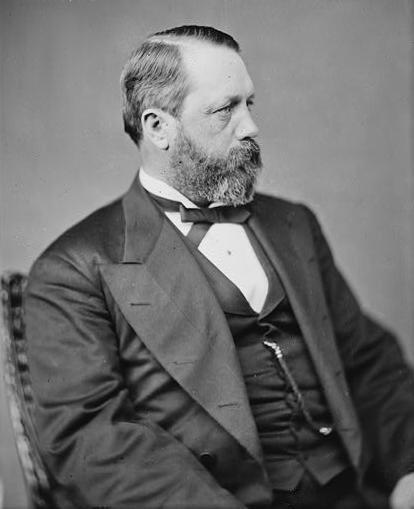
Amos Clark Jr. (November 8, 1828 – October 31, 1912) was an American Republican Party politician and businessman who represented New Jersey’s 3rd congressional district for one term from 1873 to 1875. He was born in Brooklyn, New York, on November 8, 1828. Little is recorded about his early family life, but by his youth and early adulthood he had moved into the commercial life of the New York metropolitan area, positioning himself within the growing economic networks that linked New York City with neighboring New Jersey communities.
Clark engaged in business in New York City while residing in Elizabeth, New Jersey. In Elizabeth he became largely interested in real estate, building a substantial career as a businessman and property owner. His dual engagement in New York City commerce and Elizabeth real estate reflected the broader economic expansion of the mid-nineteenth century, as the region developed into a major center of trade, transportation, and urban growth. His success in business and real estate laid the foundation for his entry into public life and gave him a prominent standing in his community.
Clark’s political career began at the local level in Elizabeth. He served as a member of the Elizabeth City Council in 1865 and 1866, participating in municipal governance during the immediate post–Civil War period, when cities in New Jersey were experiencing rapid growth and reconstruction-era adjustments. Building on this local experience, he was elected to the New Jersey Senate, serving from 1866 to 1869. In the state senate he was part of the Republican leadership that helped shape New Jersey’s policies during Reconstruction, a time marked by debates over economic development, infrastructure, and the reintegration of the nation after the Civil War.
In 1872, Clark was elected as a Republican to the United States House of Representatives from New Jersey’s 3rd congressional district. He served one term in the Forty-third Congress, from March 4, 1873, to March 3, 1875. As a member of the Republican Party representing New Jersey, Amos Clark contributed to the legislative process during this single term in office, participating in the democratic process and representing the interests of his constituents during a significant period in American history. His service in Congress coincided with the later years of Reconstruction and the economic and political challenges of the 1870s. He was an unsuccessful candidate for reelection in 1874, bringing his formal congressional service to a close after one term.
After leaving Congress, Clark retired to his residence in Norfolk County, Massachusetts, though he retained his business interests in Elizabeth, New Jersey. He continued to be associated with the commercial and real estate activities that had defined much of his earlier career, maintaining ties to the community where he had built his public and business reputation. His later years were spent largely in New England, reflecting a shift in his personal residence while his economic connections to New Jersey persisted.
Amos Clark Jr. died in Boston, Massachusetts, on October 31, 1912. He was interred in Evergreen Cemetery in Hillside, New Jersey, returning in death to the state where he had served in municipal government, the New Jersey Senate, and the United States House of Representatives. His life encompassed significant roles in business, local and state politics, and national legislative service during a transformative era in American history.
Congressional Record