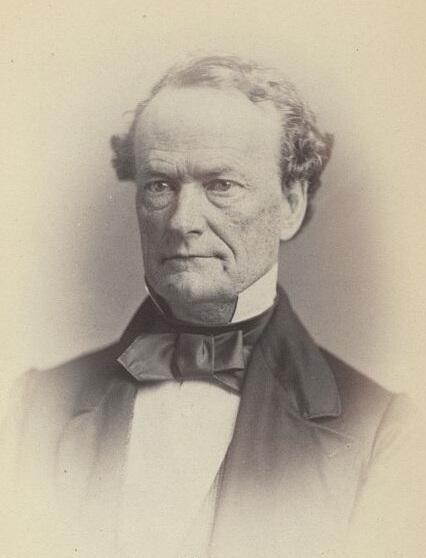
Ambrose Spencer Murray (November 27, 1807 – November 9, 1885) was an American businessman, banker, and politician from New York, best known for his service as a U.S. Representative from New York in the mid-nineteenth century. He was born in Wallkill, New York, on November 27, 1807, the seventh of nine children of William Murray and Mary Ann (Beakes) Murray. Raised on his family’s farm, he attended the local schools in Wallkill. His family was politically prominent; among his siblings was William Murray, who also later served as a member of Congress from New York, helping to establish the Murray family as an influential force in the region’s civic and political life.
At the age of seventeen, in 1824, Murray left the family farm to begin a career in commerce. He became a clerk in a Middletown, New York, store owned by his uncle, a position he held until 1831. This early experience in retail and accounting provided him with practical training in business operations and finance. In 1831 he moved to Goshen, New York, where he entered the banking field as a clerk at the Orange County Bank. Demonstrating aptitude for financial management, he was promoted to cashier in 1834. In 1845 he was chosen president of the Orange County Bank, a post he held continuously until his death in 1885, making him a central figure in the financial life of Orange County for four decades.
Murray’s business interests extended well beyond local banking. He served on the boards of directors of several important transportation and financial enterprises, including the Wallkill Valley Railroad, the Erie Railroad, and the Farmers’ Loan and Trust Company, a predecessor of Citigroup. Through these positions he was involved in the expansion of rail infrastructure and the development of financial institutions that supported economic growth in New York and beyond. His prominence in business naturally drew him into public affairs, and he became increasingly active in politics during the 1840s, particularly as sectional tensions over slavery intensified.
Politically, Murray began as a member of the Whig Party and was an early participant in national party affairs. He served as a delegate to the Whig National Convention in 1848, reflecting his rising influence within the party. That same year he was elected treasurer of Orange County, an office he held from 1848 to 1851. An opponent of slavery, he gravitated toward the anti-slavery wing of the Whigs. After the Whig Party’s collapse following the 1852 elections, he joined the coalition of former Whigs and anti-slavery Democrats that formed the short-lived Opposition Party, and later aligned with the newly organized Republican Party as the abolition movement coalesced. In October 1855 he served as a vice president of the final New York State Whig Convention, which took preliminary steps to align the remnants of the Whig organization with the emerging Republican Party.
In 1854 Murray was elected to the Thirty-fourth Congress as a member of the Opposition Party, representing New York in the U.S. House of Representatives. He took his seat on March 4, 1855. In 1856 he was reelected as a Republican to the Thirty-fifth Congress, serving until March 3, 1859. During his first term he served on the Committee on Revolutionary Claims, and during his second term he was assigned to the Committee on Mileage. His congressional career was marked by firm opposition to the extension of slavery. When Congress considered the pro-slavery Lecompton Constitution for Kansas in 1858, Murray, who was then in mourning for the death of one of his sons and attending to his ill wife in Goshen, returned to Washington in time to cast his vote against its approval. He gained particular notice in 1856 when, during the caning of Senator Charles Sumner by Representative Preston Brooks on the Senate floor, he was one of the two Representatives who intervened to halt the assault and secure medical assistance for Sumner, an incident that underscored both his anti-slavery convictions and his personal courage.
After leaving Congress in 1859, Murray resumed his banking and business activities in Goshen, continuing as president of the Orange County Bank and as a director of major railroads and financial institutions. He remained active in Republican politics and served as a delegate to the 1860 Republican National Convention, which nominated Abraham Lincoln for the presidency. In the years before the abolition of slavery, Murray used his position as a director of the Erie Railroad to assist fugitive slaves, obtaining free tickets and passes that enabled them to travel northward and escape to Canada. This activity complemented his long-standing public opposition to slavery and placed him among those northern businessmen who quietly supported the operations of the Underground Railroad.
During the American Civil War, Murray played a significant role in local mobilization for the Union cause. Governor Edwin D. Morgan appointed committees of leading citizens in each New York county to oversee recruiting and equipping troops. Murray served as Goshen’s representative on the Orange County Committee and was instrumental in raising and outfitting the 124th New York Volunteer Infantry Regiment, composed largely of men from Orange County and known as the “Orange Blossoms.” His commitment to the Union effort was also personal: two of his sons, George and Wisner Murray, served in the Union Army as members of the 7th New York Volunteer Infantry Regiment.
In his private life, Murray married Frances Wisner (1814–1906) in 1836. She was the daughter of Henry G. Wisner and Sarah (Talman) Wisner, members of another prominent Orange County family. Ambrose and Frances Murray were the parents of six children: Ellen, George W., Wisner, Ambrose S. Jr., Russell, and Francis W. The family’s social and civic standing in Goshen reflected Murray’s combined prominence in finance, politics, and community affairs.
Ambrose Spencer Murray died in Goshen, New York, on November 9, 1885, after a long career in business and public service that spanned more than half a century. He was interred at Saint James’ Cemetery in Goshen. At the time of his death he was still serving as president of the Orange County Bank, a position he had held since 1845, and he was remembered locally and nationally for his leadership in banking, his early and consistent opposition to slavery, and his service in Congress during one of the most turbulent periods in the nation’s history.
Congressional Record