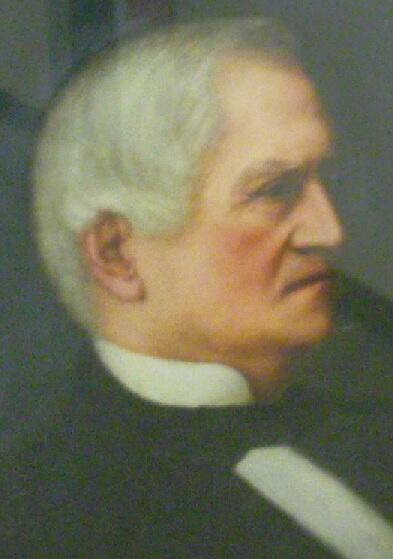
Amaziah Bailey James (July 1, 1812, in Stephentown, Rensselaer County, New York – July 6, 1883, in Ogdensburg, St. Lawrence County, New York) was an American lawyer, jurist, and Republican politician from New York. Born in eastern New York, he moved with his family in 1814 to Sweden, New York, in Monroe County, where he spent his early childhood on the western frontier of the state. His formal schooling was limited, and at the age of fourteen he was apprenticed to a printer in Batavia, New York, an experience that introduced him to the world of publishing, public affairs, and political discourse.
In 1831, James removed to Ogdensburg, in St. Lawrence County, where he entered the newspaper business at a time when party presses were central to local and state politics. He edited the Northern Light, a weekly newspaper, and later became co-owner of the Times and Advertiser, the Whig paper of St. Lawrence County. Through his editorial work he became a prominent local voice for Whig principles and public issues in northern New York. His involvement in the press helped establish his reputation in the community and laid the groundwork for his later legal and political career.
Alongside his work in journalism, James became active in the state militia. In 1836 he was commissioned captain of the Ogdensburg Artillery, reflecting both his standing in the community and the importance of local militia organizations in antebellum New York. He subsequently rose through the ranks and was promoted to major general of the New York State Militia, a position that underscored his leadership role in regional military affairs during a period when citizen-soldiers formed a key component of state defense and public order.
James studied law while residing in Ogdensburg and was admitted to the bar in 1838. He commenced legal practice in Ogdensburg, building a career as an attorney that paralleled his growing prominence in civic life. His legal abilities and public reputation led to his election as a justice of the New York Supreme Court for the 4th Judicial District, a position he held from 1854 to 1876. By virtue of that office, he served ex officio as a judge of the New York Court of Appeals in 1861 and again in 1869, participating in the work of the state’s highest court. In 1861 he was also a member of the peace convention held in Washington, D.C., an extraordinary gathering of delegates from various states that sought, unsuccessfully, to devise means to prevent the impending Civil War. His participation in that convention reflected his engagement with national issues at a moment of profound constitutional crisis.
After more than two decades on the bench, James entered national legislative service. As a member of the Republican Party representing New York, he was elected to the Forty-fifth and Forty-sixth United States Congresses and served from March 4, 1877, to March 3, 1881. His two terms in the House of Representatives coincided with the end of Reconstruction and the beginning of the Gilded Age, a significant period in American history marked by contested federal policies, economic change, and shifting party alignments. During this time, he contributed to the legislative process, participating in the democratic governance of the nation and representing the interests of his constituents from northern New York. While serving his second term in Congress, he was stricken with “paralysis,” from which he only partially recovered, a condition that affected his capacity for further public service and led to his retirement from national office at the close of his second term.
In his later years, James lived in Ogdensburg, where he had long been a central figure in legal, military, and political circles. He died there on July 6, 1883. He was buried at the City Cemetery in Ogdensburg, St. Lawrence County, New York, closing a career that had spanned journalism, militia leadership, the state judiciary, and service in the United States Congress.
Congressional Record