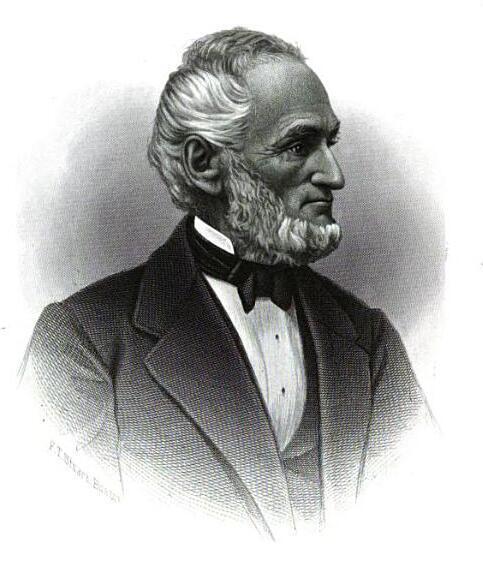
Amasa Walker (May 4, 1799 – October 29, 1875) was an American economist, educator, reformer, and United States Representative from Massachusetts. He was born in Woodstock, Connecticut, and moved with his parents in childhood to North Brookfield, Massachusetts, where he attended the district school. He was the father of Francis Amasa Walker, who later became a prominent economist, Civil War officer, and president of the Massachusetts Institute of Technology.
Walker entered commercial life in 1814, beginning a business career while still a young man. In 1820 he formed a mercantile partnership with Allen Newell in North Brookfield, but three years later withdrew to become the agent of the Methuen Manufacturing Company, a textile concern in Methuen, Massachusetts. In 1825 he entered into business in Boston as a partner in the firm of Carleton and Walker with Charles G. Carleton, and in 1827 he established himself as an independent businessman in that city. His early commercial experience, particularly in manufacturing and trade, strongly influenced his later work in political economy and finance.
By the mid-1830s Walker had become active in Democratic Party politics and in urban affairs. He served as a delegate to the 1836 Democratic National Convention and was the unsuccessful Democratic nominee for mayor of Boston in the 1837 Boston mayoral election. During this period he also emerged as a prominent advocate of social reform. In 1839 he became president of the Boston Temperance Society, the first total abstinence association in that city, and the same year he publicly advocated the construction of a continuous railway line between Boston and the Mississippi River, reflecting his interest in internal improvements and national economic development. In 1840 he retired from commercial life and turned his attention to scholarship, public lecturing, and reform.
Walker’s academic career in political economy extended over several decades and multiple institutions. From 1842 to 1848 he lectured on political economy at Oberlin College in Ohio, one of the nation’s leading reformist and coeducational institutions. He later served from 1853 to 1860 as an examiner in political economy at Harvard University, and from 1859 to 1869 he was a lecturer on political economy at Amherst College in Massachusetts. Amherst College conferred upon him the honorary degree of LL.D. in 1867 in recognition of his contributions to economic thought and teaching. Throughout these years he was a frequent contributor to periodical literature, especially on financial and monetary subjects, and beginning in 1857 he published a series of influential articles on political economy in Hunt’s Merchant’s Magazine.
In addition to his teaching, Walker was a prolific author on economic and financial questions. His principal work, The Science of Wealth: A Manual of Political Economy, Embracing the Laws of Trade, Currency, and Finance, was published in Boston by Little, Brown & Co. in 1866 and became a widely used text in the United States. Among his other writings were Nature and Uses of Money and Mixed Currency (Boston, 1857), which addressed contemporary debates over banking and paper money, and, in collaboration with William B. Calhoun and Charles L. Flint, the multi-volume Transactions of the Agricultural Societies of Massachusetts (7 volumes, 1848–1854), reflecting his interest in agriculture and rural economy.
Walker was deeply involved in the anti-slavery movement and in the political realignments that preceded the Civil War. In 1843 he served as a delegate to the first International Peace Congress in London, and in 1849 he participated in the Peace Congress held in Paris, underscoring his commitment to international peace and reform. In 1848 he was one of the founders of the Free Soil Party, which opposed the extension of slavery into the western territories. His political career in Massachusetts state government began soon afterward. He served in the Massachusetts House of Representatives in 1849 and again in 1860, and in the Massachusetts State Senate in 1850. From 1851 to 1853 he held statewide executive office as Secretary of the Commonwealth of Massachusetts. In 1853 he was chosen a member of the convention called to revise the Massachusetts state constitution and served as chairman of the committee on suffrage, a position that placed him at the center of debates over voting rights and representation. In the presidential election of 1860 he was selected as a member of the Massachusetts electoral college and cast his ballot for Abraham Lincoln, reflecting his alignment by that time with the emerging Republican Party.
Walker’s service in the United States Congress came during the Civil War. He was elected as a Republican to the Thirty-seventh Congress to fill the vacancy caused by the death of Representative Goldsmith Bailey and served as a member of the United States House of Representatives from Massachusetts from 1862 to 1863. As a member of the Republican Party representing Massachusetts, he contributed to the legislative process during his one term in office, participating in the democratic process at a significant moment in American history and representing the interests of his constituents while the Union was engaged in civil conflict and the national economic and financial systems were under intense strain.
In his later years, Walker continued to write and lecture on economic, financial, and social questions, maintaining his reputation as one of the leading American economists of his generation. His work influenced both academic discourse and public policy debates on currency, banking, and trade in the mid-nineteenth century. He died on October 29, 1875, leaving a legacy as a businessman-turned-scholar, reformer, and public servant, and as the patriarch of a family that remained prominent in American intellectual and public life through his son, Francis Amasa Walker.
Congressional Record