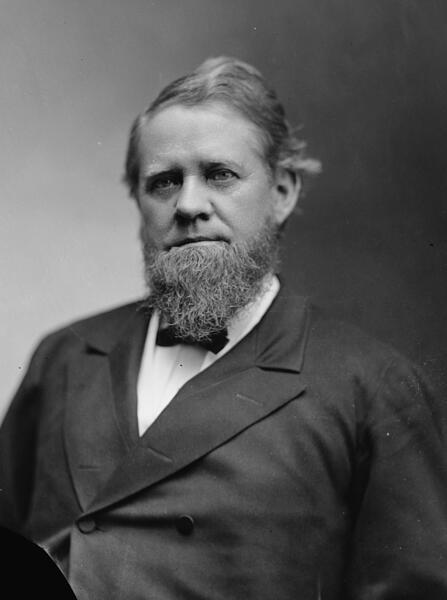
Amasa Norcross (January 26, 1824 – April 2, 1898) was a Republican member of the United States House of Representatives from Massachusetts who served three consecutive terms in Congress from 1877 to 1883. Over the course of a long career in law and public office at the local, state, and federal levels, he represented the interests of his constituents during a significant period in American political and economic development following the Civil War.
Norcross was born in Rindge, Cheshire County, New Hampshire, on January 26, 1824. He was educated in the common schools of his native region and later attended Appleton Academy in New Ipswich, New Hampshire, an institution that prepared many young men of the era for professional and civic careers. His early education provided the foundation for his subsequent legal training and public service in neighboring Massachusetts.
After completing his studies at Appleton Academy, Norcross read law and was admitted to the bar in 1847. He began the practice of law in Worcester, Massachusetts, an important commercial and industrial center in the Commonwealth. Establishing himself as an attorney in Worcester placed him within a growing professional community and brought him into contact with the legal and political issues of a rapidly industrializing state. His legal practice would remain the core of his professional life, to which he returned whenever he was not in public office.
Norcross entered public life as a member of the Massachusetts House of Representatives, serving in that body in 1858, 1859, and again in 1862. His legislative service coincided with the turbulent years leading up to and during the early period of the Civil War, when Massachusetts played a prominent role in national politics and in support of the Union cause. In addition to his work in the state legislature, he was appointed assessor of internal revenue in August 1862, a federal position created as part of the Union government’s wartime revenue system. He served as assessor of internal revenue from August 1862 until May 1873, when the office was abolished as part of a reorganization of the federal tax structure. In this capacity he was responsible for overseeing the assessment of federal taxes in his district during a period of expanding federal fiscal authority.
Following his long tenure as an internal revenue assessor, Norcross continued his public service at the municipal and state levels. He served as mayor of the city of Fitchburg, Massachusetts, in 1873 and 1874, guiding the community at a time when many New England towns were experiencing industrial growth and urban development. In 1874 he also served in the Massachusetts Senate, further extending his experience in state government. His legislative work in both houses of the Massachusetts General Court, including representation of the 6th Worcester district in the Massachusetts House of Representatives, helped establish his reputation as a capable Republican leader and prepared him for national office.
Norcross was elected as a Republican to the Forty-fifth, Forty-sixth, and Forty-seventh Congresses, serving in the U.S. House of Representatives from March 4, 1877, to March 3, 1883. As a member of the House of Representatives, he participated in the legislative process during a critical post-Reconstruction era marked by debates over economic policy, federal taxation, and the role of the federal government in regulating commerce and industry. Representing Massachusetts, he took part in the democratic process on behalf of his constituents and contributed to the deliberations of the national legislature over three consecutive terms. He chose not to be a candidate for renomination in 1882, thereby concluding his congressional career at the end of the Forty-seventh Congress.
After leaving Congress in March 1883, Norcross resumed the practice of law, returning to his profession and to private life while remaining a respected figure in Massachusetts public affairs. In his later years he maintained close family ties, including with his daughter, Eleanor Norcross, who became a noted painter and art patron. While on a visit to Eleanor in Paris, France, Amasa Norcross died there on April 2, 1898. His remains were returned to Massachusetts, and he was interred in Laurel Hill Cemetery in Fitchburg, Massachusetts, closing a life that had spanned local, state, and national service during a transformative period in American history.
Congressional Record