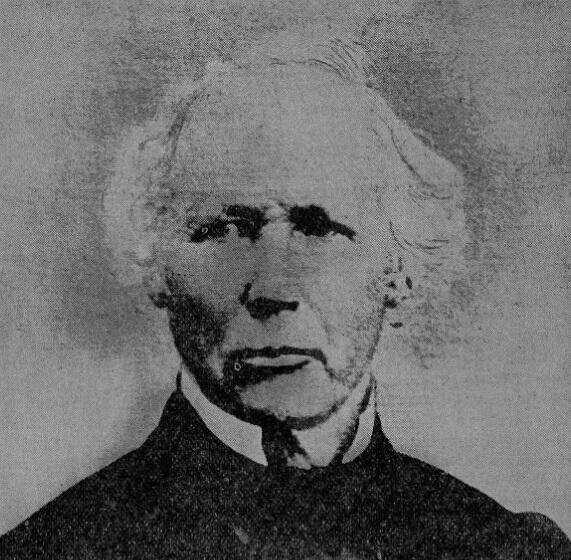
Amasa Dana (October 19, 1792 – December 24, 1867) was an American lawyer and Democratic politician who served two non-consecutive terms as a U.S. Representative from New York, from 1839 to 1841 and from 1843 to 1845. He was born in Wilkes-Barre, Pennsylvania, the son of Aziel Dana and Rebecca (Cory) Dana. Raised in a family of New England ancestry that had moved into the Wyoming Valley, he attended private schools and Dana Academy in Wilkes-Barre, receiving a classical education that prepared him for the study of law.
After completing his preliminary studies, Dana moved to New York to read law under the supervision of his uncle, Eleazer Dana, in Owego, then in Tioga County. He studied in his uncle’s office until he attained admission to the bar in 1817. Following his admission, he commenced the practice of law in Owego, building a regional practice in a period when the Southern Tier of New York was rapidly developing. His early legal career established his reputation as a capable attorney and positioned him for subsequent public responsibilities.
In 1821, Dana relocated to Ithaca, New York, in Tompkins County, where he continued the practice of law. His abilities as a lawyer and his growing prominence in the community led to his appointment as district attorney of Tompkins County, a post he held from 1823 to 1837. In this capacity he was responsible for prosecuting criminal cases and advising county officials, and he played a significant role in shaping the administration of justice in the region during a formative period. Dana also entered state politics, serving as a member of the New York State Assembly in 1828 and 1829, where he participated in legislative deliberations at Albany. At the local level, he was repeatedly entrusted with municipal leadership, serving as president and trustee of the village of Ithaca in 1835, 1836, and again in 1839, reflecting the confidence of his fellow citizens in his judgment and administrative skills.
Dana’s judicial career advanced when, in 1837, he was elected judge of the Court of Common Pleas of Tompkins County. As a judge of this county-level court, he presided over civil and criminal matters at a time when local courts were central to the resolution of disputes in New York. His combined experience as prosecutor, legislator, municipal officer, and judge provided a broad foundation for his later national service. In addition to his public duties, he continued to be active in the legal profession and local affairs, becoming a well-known figure in Ithaca’s civic life.
Dana was elected as a Democrat to the Twenty-sixth Congress, serving from March 4, 1839, to March 3, 1841, representing a New York district in the U.S. House of Representatives. As a member of the Democratic Party representing New York, he contributed to the legislative process during a significant period in American history, participating in the democratic process and representing the interests of his constituents during the closing years of the Van Buren administration and the onset of the Whig ascendancy under President William Henry Harrison and then John Tyler. He was not a candidate for renomination in 1840 and, upon the expiration of his term, resumed the practice of law in Ithaca. From 1842 to 1843, he returned to local office as Ithaca’s town supervisor, further underscoring his continued engagement in public affairs at multiple levels of government.
In 1842, Dana again sought national office and was elected to the Twenty-eighth Congress, serving from March 4, 1843, to March 3, 1845. During this second, non-consecutive term in the House of Representatives, he served as chairman of the Committee on Expenditures in the Department of the Navy, overseeing and reviewing the fiscal administration and spending practices of that executive department. His service in Congress during these two terms coincided with debates over economic policy, territorial expansion, and governmental reform, and he took part in the legislative work of a nation on the eve of the Mexican–American War and the annexation of Texas.
After leaving Congress in 1845, Dana resumed the active practice of law in Ithaca and broadened his interests to include banking and business. He became involved in the financial development of Tompkins County and served as president of the Tompkins County National Bank, a position that placed him at the center of local economic affairs in the mid-nineteenth century. His legal, political, and business activities made him one of the leading figures in Ithaca’s professional and civic community over several decades.
In his personal life, Dana married Mary Harper Speed in 1828. She was the daughter of Doctor Joseph Speed of Caroline, New York, a nearby community in Tompkins County. The marriage produced no children, and the couple’s household remained without direct heirs. Dana continued to reside in Ithaca for the remainder of his life, maintaining his professional engagements and local connections well into his later years.
Amasa Dana died in Ithaca, New York, on December 24, 1867. He was interred in Ithaca City Cemetery, where his grave marks the resting place of a lawyer, judge, legislator, and businessman who participated in local, state, and national affairs during a transformative era in American history.
Congressional Record