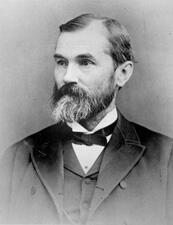
Alvin Saunders (July 12, 1817 – November 1, 1899) was a U.S. Senator from Nebraska and the final and longest-serving governor of the Nebraska Territory, holding the latter office through most of the American Civil War. A member of the Republican Party, he later represented Nebraska in the United States Senate from 1877 to 1883, serving one full term during a significant period in American political and economic development.
Saunders was born on July 12, 1817, in Fleming County, Kentucky, where he spent his early years in a rural setting typical of the early nineteenth-century American frontier. In his youth, he moved with his family to Illinois and then to Mount Pleasant in the Iowa Territory, part of the broader westward migration that shaped his generation’s political outlook. Growing up amid the expansion of settlement and the organization of new territories, he developed an early interest in public affairs and commerce, experiences that would later inform his territorial and senatorial careers.
Saunders’s formal education was limited to the common schools of his time, but he pursued self-education and quickly became active in local business and civic life. In Mount Pleasant he engaged in mercantile pursuits and community leadership, gaining prominence in the developing town. His involvement in local affairs led naturally into politics as the territories of the Midwest moved toward more formal organization and eventual statehood, and he became identified with the emerging Republican Party in the 1850s.
Saunders’s political career advanced as he took on roles in territorial governance and party organization. He served in the Iowa Territorial Legislature and participated in the early Republican Party conventions, aligning himself with the Union cause and the anti-slavery platform that defined Republican politics in the years leading up to the Civil War. His reliability as a party leader and his support for the Lincoln administration brought him to national attention at a time when the federal government was consolidating control over the western territories.
In 1861 President Abraham Lincoln appointed Saunders governor of the Nebraska Territory, a position he would hold longer than any of his predecessors and that made him the final territorial governor before Nebraska achieved statehood. His tenure, which extended through most of the American Civil War, required him to oversee the territory’s administration during a period of national conflict and regional uncertainty. As governor, he dealt with issues of frontier security, relations with Native American tribes, and the organization of territorial institutions, while also supporting the Union war effort and encouraging settlement and infrastructure development that would prepare Nebraska for eventual admission to the Union.
Following Nebraska’s transition from territory to state, Saunders remained an influential Republican figure in the region. Drawing on his long executive experience, he continued to participate in party affairs and public life, helping to shape the political identity of the new state. His reputation as a steady administrator and loyal Republican made him a natural candidate for higher office once Nebraska secured full representation in Congress.
Saunders was elected as a Republican to the United States Senate and served as a Senator from Nebraska from March 4, 1877, to March 3, 1883. During his one term in office, he contributed to the legislative process at a time marked by the end of Reconstruction, the rise of industrialization, and the continued development of the American West. In the Senate he represented the interests of his Nebraska constituents, particularly in matters related to western settlement, railroads, and federal support for infrastructure and economic growth. His service in Congress occurred during a significant period in American history, and he participated fully in the democratic process as the young state sought to secure its place in the national economy and political system.
After leaving the Senate in 1883, Saunders returned to private life in Nebraska, remaining a respected elder statesman within the Republican Party and his community. He lived to see the continued growth and consolidation of the state whose territorial development he had helped guide. Alvin Saunders died on November 1, 1899, closing a public career that had spanned the formative decades of Nebraska’s transition from frontier territory to fully integrated state within the Union.
Congressional Record