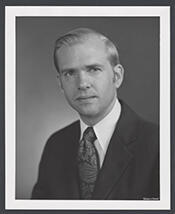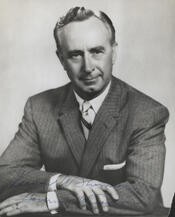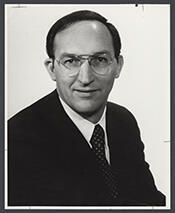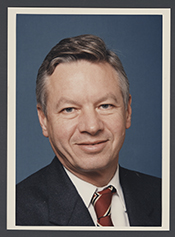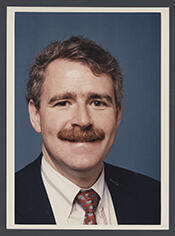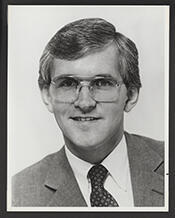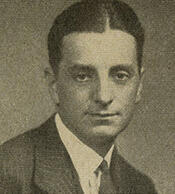
Alvin Edward O’Konski (May 26, 1904 – July 8, 1987) was an American politician and educator who served 30 years in the United States House of Representatives. A member of the Republican Party, he represented northwestern Wisconsin, including Wisconsin’s 10th congressional district, from January 3, 1943, until January 3, 1973. Over the course of 15 consecutive terms in office, O’Konski contributed to the legislative process during a significant period in American history, participating in the democratic process and representing the interests of his constituents in the House of Representatives.
O’Konski was born on a farm near Kewaunee, Wisconsin, on May 26, 1904, to Antonia (née Paska) and Frank O’Konski. He attended local public schools in the Kewaunee area before pursuing higher education. He studied at the University of Iowa and later enrolled at the State Teachers College in Oshkosh, Wisconsin (now the University of Wisconsin–Oshkosh), from which he graduated in 1927. Continuing his education, he attended the University of Wisconsin (now the University of Wisconsin–Madison), earning a degree there in 1932. His academic training laid the foundation for a career that combined education, public communication, and politics.
Before entering national politics, O’Konski established himself as an educator and school administrator in the Midwest and Pacific Northwest. He began his professional career as a high school teacher in Omro and Oconto, Wisconsin, from 1926 to 1929. He then served as a member of the faculty at Oregon State College in Corvallis, Oregon, from 1929 to 1931. Returning to Wisconsin, he became superintendent of schools in Pulaski, serving in that capacity from 1932 to 1935. In 1936 he taught at a junior college in Coleraine, Minnesota, and later that year joined the faculty of the University of Detroit, where he remained until 1938. By 1940, O’Konski had settled in Hurley, Wisconsin, where from 1940 to 1942 he worked as an educator, journalist, lecturer, editor, and publisher, broadening his public profile and deepening his engagement with civic affairs.
O’Konski’s political career began in earnest with his election to the United States House of Representatives in 1942. Chosen as a Republican to the 78th Congress, he took office on January 3, 1943, and was subsequently reelected to the fourteen succeeding Congresses, serving continuously until January 3, 1973. Throughout his tenure, he represented Wisconsin’s 10th congressional district, which encompassed much of the northwestern part of the state, including communities such as Rhinelander and Superior. His three decades in Congress coincided with World War II, the early Cold War, the civil rights era, and the Vietnam War, and he participated in shaping federal policy during these transformative years.
During his congressional service, O’Konski took notable positions on major national issues, particularly in the area of civil rights. He voted in favor of the Civil Rights Acts of 1957, 1960, 1964, and 1968, supporting landmark legislation aimed at ending segregation and protecting the rights of African Americans. He also supported the 24th Amendment to the United States Constitution, which abolished the poll tax in federal elections, and voted for the Voting Rights Act of 1965, which sought to eliminate barriers to voting for minority citizens. In 1957, he sought higher office as a candidate in the Republican primary for the special election to fill the United States Senate seat left vacant by the death of Senator Joseph McCarthy, but he was unsuccessful in that bid and continued his work in the House.
O’Konski’s long tenure in Congress came to an end following redistricting after the 1970 census. Wisconsin lost a congressional district, and most of his long-held territory was merged into the 7th congressional district, represented by three-term Democrat Dave Obey. In the new configuration, O’Konski retained only about 40 percent of his former constituency, a disadvantage that diminished the electoral strength built up over his years of service. In the 1972 election, despite his seniority and the fact that President Richard Nixon carried most of the district at the presidential level, O’Konski was defeated. Observers at the time noted that his support for a controversial proposed Navy communications project known as Project Sanguine, which was to be located in Wisconsin, may have contributed to his loss.
In addition to his legislative work, O’Konski was active in broadcasting and local media while still serving in Congress. He founded WAEO‑TV, the NBC affiliate for much of north-central Wisconsin, expanding his influence as a communicator and public figure. The station, which served viewers in the region for several years under his ownership, was sold by O’Konski in 1976 and later became known as WJFW‑TV. His involvement in television reflected his broader interest in education, information, and public discourse, themes that had marked his earlier career as a teacher, administrator, and publisher.
After leaving Congress, O’Konski returned to private life in his native Wisconsin. He lived in Kewaunee, maintaining ties to the community where he had been born and educated. Alvin Edward O’Konski died in Kewaunee on July 8, 1987. He was buried at St. Hedwig’s Cemetery, a rural church cemetery west of Kewaunee, closing a life that spanned more than eight decades and included service as an educator, media figure, and long‑time representative of northwestern Wisconsin in the United States House of Representatives.
Congressional Record