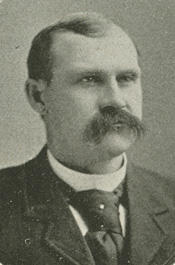
Alva Lysander Hager (October 29, 1850 – January 29, 1923) was a three-term Republican member of the United States House of Representatives from Iowa’s 9th congressional district in the 1890s. He served as a Representative from Iowa in the United States Congress from 1893 to 1899, contributing to the legislative process during three terms in office and representing the interests of his constituents during a significant period in American political and economic history.
Hager’s service in Congress began when he was elected as a Republican to the Fifty-third Congress, taking office on March 4, 1893. He was subsequently re-elected to the Fifty-fourth and Fifty-fifth Congresses, serving continuously until March 3, 1899. As a member of the House of Representatives, Hager participated in the democratic process at a time marked by debates over tariffs, monetary policy, and the role of the federal government in regulating commerce and industry. A member of the Republican Party, he aligned with the dominant Republican positions of his era, which generally favored protective tariffs and a sound currency, and he took part in shaping legislation affecting both Iowa and the broader nation.
In August 1898, Hager sought renomination for his congressional seat but was defeated in a closely contested race for the Republican nomination by Smith McPherson. The nomination contest drew four serious candidates and extended over several days, during which no candidate initially secured the required number of votes. The deadlock was finally broken on the 618th ballot, when McPherson prevailed after Hager threw his support to him. This outcome ended Hager’s tenure in Congress at the close of the Fifty-fifth Congress, with his service formally concluding on March 3, 1899.
After leaving Congress, Hager resumed the practice of law, returning to the profession that had underpinned his public career. In 1901 he moved to Des Moines, Iowa, where he continued to practice law and remained active in professional and civic affairs. Expanding his interests beyond the legal field, he engaged in banking from 1911 to 1918, reflecting the broader involvement of many former legislators in finance and business during the early twentieth century. His post-congressional years thus combined legal practice with participation in the economic life of his state.
Alva Lysander Hager died in Des Moines, Iowa, on January 29, 1923. He was interred in the Hrabak Funeral Home vault. His career in public office, particularly his three terms in the U.S. House of Representatives from March 4, 1893, to March 3, 1899, placed him among the Republican lawmakers who helped guide the United States through a period of industrial expansion, political realignment, and growing national influence at the close of the nineteenth century.
Congressional Record