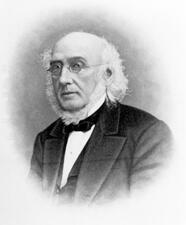
Alpheus Felch (September 28, 1804 – June 13, 1896) was the fifth governor of Michigan and a United States Senator from Michigan. He was born in Limerick, in what is now the state of Maine but was then a part of Massachusetts. Orphaned at the age of three, he was raised by his grandfather, Abijah Felch, a veteran of the American Revolution. His early education included attendance at Phillips Exeter Academy in Exeter, New Hampshire, after which he enrolled at Bowdoin College in Brunswick, Maine. He graduated from Bowdoin in 1827, then studied law and was admitted to the bar in Bangor, Maine. From 1830 to 1833 he practiced law in Houlton, Maine, before deciding to seek broader opportunities in the developing West.
In 1833, Felch moved to Monroe, Michigan, where he continued the practice of law and quickly became involved in public affairs in the new state. During the mustering of troops for the Ohio–Michigan Boundary Dispute, commonly known as the Toledo War, he served in 1835 as aide-de-camp to General Joseph Brown. That same year he was elected to the Michigan State House of Representatives, where he served from 1835 to 1837, being elected three times. His legislative service coincided with Michigan’s transition from territory to statehood and the organization of its early civil institutions.
Felch’s growing reputation as a careful lawyer and public servant led to a series of important state appointments. In 1838 he was appointed state bank commissioner, a position he held until his resignation in 1839. As bank commissioner, he played a significant role in exposing frauds that had been enabled by a general “wildcat” banking law, which he had opposed and which was later declared unconstitutional by the Michigan Supreme Court. In 1842 he briefly served as state auditor general before being appointed associate justice of the Michigan Supreme Court later that year. He sat on the state’s highest court from 1842 until his resignation in 1845, when he left the bench after being elected governor.
Felch served as the fifth governor of Michigan from 1846 to 1847. During his approximately fourteen months in office, state statutes were amended in a variety of areas, and one of the most consequential actions of his administration was the relocation of the state capital from Detroit to Lansing. His tenure reflected the ongoing efforts to stabilize Michigan’s finances and institutions in the wake of earlier banking and internal improvement difficulties. He resigned the governorship on March 3, 1847, following his election by the Michigan legislature as a Democrat to the United States Senate.
Alpheus Felch served as a Senator from Michigan in the United States Congress from March 4, 1847, to March 3, 1853, encompassing the 30th, 31st, and 32nd Congresses. A member of the Democratic Party, he contributed to the legislative process during this single term in office, representing the interests of his Michigan constituents during a significant period in American history marked by territorial expansion and sectional tensions. In the Senate, he served for four years as chairman of the Committee on Public Lands, where he was involved in shaping federal policy on the disposition and management of the public domain.
After leaving the Senate in 1853, Felch was appointed in March of that year by President Franklin Pierce to the federal land claims commission for California, created to adjudicate Spanish and Mexican land claims arising from the Treaty of Guadalupe Hidalgo, which ended the Mexican–American War. He served as president of this commission until 1856, overseeing complex legal and historical questions related to property rights in the newly acquired territory. In 1856 he returned to Michigan and settled in Ann Arbor. That year he made an unsuccessful attempt to regain the governorship in a non-consecutive term, running against the Republican incumbent, Kinsley S. Bingham.
In his later years, Felch resumed the practice of law in Ann Arbor and remained an influential figure in Michigan’s legal and civic life. From 1879 to 1883 he served as the Tappan Professor of Law at the University of Michigan, contributing to the education of a new generation of lawyers. His long life spanned from the early national period through the post–Civil War era, and he was widely regarded as one of the formative figures in Michigan’s early statehood.
Alpheus Felch died at his home in Ann Arbor, Michigan, on June 13, 1896, at the age of 91. He was interred at Forest Hill Cemetery in Ann Arbor, where he is buried alongside his wife, Lucretia. His legacy in the state is reflected in several place names, including Felch Township in Michigan and Felch Park on the University of Michigan campus, both named in his honor.
Congressional Record