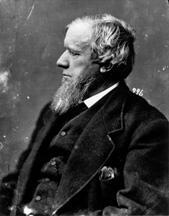
Allen Granberry Thurman (November 13, 1813 – December 12, 1895) was an American politician and lawyer who served as a United States representative from Ohio, justice of the Ohio Supreme Court, and United States senator. A prominent member of the Democratic Party, he was known nationally as the “Old Roman” for his austere manner and reputation for integrity. He was the Democratic nominee for vice president of the United States in 1888 as the running mate of President Grover Cleveland, though the ticket was defeated in the general election.
Thurman was born in Lynchburg, Virginia, and in his youth moved with his family to Chillicothe, Ohio, which became his lifelong home and political base. He read law and was admitted to the bar, establishing a legal practice in Chillicothe in partnership with his uncle, William Allen, who later represented Ohio in the United States Senate and served as governor. Thurman quickly gained distinction at the bar, developing a reputation for intellectual rigor and skill in argument. On November 14, 1844, he married Mary Anderson Dun Tompkins of Lexington, Kentucky, the daughter of wealthy landowner Walter Dun. She was a widow, her first husband having died in 1840. Together, Allen and Mary Thurman had five children, including Allen W. Thurman, later known as a eugenicist and baseball executive; Mary Thurman, who married William S. Cowles, Thomas Scott Gifford, and baseball player Bug Holliday; and Elizabeth Thurman, who married Richard Cunningham McCormick, a territorial governor of Arizona.
Thurman entered national politics as a Democrat and won election to the United States House of Representatives in 1844, becoming at that time the youngest member of that body. He served a single term in the Twenty-ninth Congress from March 4, 1845, to March 3, 1847. During his service in the House, he supported the administration of President James K. Polk in the conduct of the Mexican–American War and voted for the Wilmot Proviso, which sought to prohibit slavery in any territory acquired from Mexico. After leaving the House, he returned to Ohio and continued his legal career, rising to further prominence in state affairs.
Thurman’s judicial career began when he was elected to the Supreme Court of Ohio, where he served as a justice and later as chief justice. His tenure on the state’s highest court enhanced his standing as a constitutional lawyer and helped position him as a leading figure in Ohio’s Democratic Party. In 1867, he ran for governor of Ohio on a platform explicitly opposed to extending suffrage to Black citizens. In that campaign, statewide Democrats, including Thurman, rallied under the slogan “No Negro Equality!” and he appealed to white supremacist attitudes in virulent tones, vowing to fight what he called “the thralldom of n*****ism.” In Ohio, as in many Northern states, referendums on Black suffrage failed in part because small numbers of Republican voters joined Democratic opposition, and Democratic politicians, including Thurman, seized upon the issue with race-baiting rhetoric. In the general election he narrowly lost to Republican Rutherford B. Hayes, a future president of the United States.
Thurman was elected by the Ohio legislature to the United States Senate in 1869, beginning his service in that body on March 4, 1869. He served until March 3, 1881, completing two full terms, during a significant period in American history marked by Reconstruction and its aftermath. As a senator from Ohio, he participated actively in the legislative process and represented the interests of his constituents while emerging as a leading Democratic critic of Republican Reconstruction policies. He opposed many of the civil rights measures enacted during Reconstruction, actively campaigned against African-American voting rights, and worked to reverse civil rights advances. In Congress he offered an amendment to continue segregation in the public schools of the District of Columbia. During the disputed presidential election of 1876 between Rutherford B. Hayes and Samuel J. Tilden, Thurman played a key role in helping to establish the Electoral Commission that ultimately resolved the contest. He lost reelection in 1881 when Republicans gained control of the Ohio legislature, ending his formal Senate career, which had extended from 1869 to 1881 and encompassed three Congresses.
Even after leaving the Senate, Thurman remained an influential figure in Democratic politics. He was put forward as a “favorite son” presidential candidate at the Democratic national conventions of 1880 and 1884, reflecting his stature among “old-line” Democrats who were wary of newer reform currents in the party. In the concurrent 1884 United States Senate election in Ohio, he did not oppose the campaign of incumbent Democratic senator George H. Pendleton, who faced opposition within the party for sponsoring the Pendleton Civil Service Reform Act, which curtailed patronage politics. When Vice President Thomas A. Hendricks died in office in November 1885, Thurman’s name again rose to national prominence. At the 1888 Democratic National Convention, he was selected as President Grover Cleveland’s running mate. His appeal lay in his popularity with traditional Democrats and his known hostility to railroad monopolists, which balanced concerns about Cleveland’s more liberal tendencies. Democrats turned Thurman’s trademark red bandana handkerchief into a symbol of the campaign, waving red bandanas in parades and manufacturing bandanas bearing the candidates’ likenesses. The Cleveland–Thurman ticket emphasized issues such as reducing federal taxes and protective tariffs. However, Thurman, then elderly and largely retired from active politics, did not conduct a vigorous campaign and added little electoral strength to the ticket, which was defeated in the 1888 election.
In his later years, Thurman retired from public life in Ohio but remained a respected elder statesman within the Democratic Party. He supported Grover Cleveland’s successful bid for a second, nonconsecutive term in 1892, though he was not considered for the vice presidency, which went instead to Adlai Stevenson. In retirement, Thurman devoted himself to intellectual pursuits; he was known to read French novels in the original language, to play whist, and to amuse himself with mathematical problems, enjoying a reputation as one of the best amateur mathematicians in Ohio. Allen Granberry Thurman died on December 12, 1895. His long career, spanning service in the House of Representatives, on the Ohio Supreme Court, and in the United States Senate, together with his 1888 vice-presidential candidacy, left a complex legacy in both Ohio and national political history.
Congressional Record