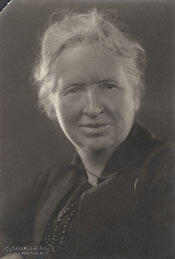
Alice Mary Robertson (January 2, 1854 – July 1, 1931) was an American educator, social worker, Native Americans’ rights activist, government official, and politician who became the second woman to serve in the United States Congress and the first from the state of Oklahoma. A member of the Republican Party, she served one term as a Representative from Oklahoma’s 2nd Congressional District in the 67th Congress from March 4, 1921, to March 3, 1923. Robertson was the first woman elected to Congress after the ratification of the Nineteenth Amendment guaranteeing women the right to vote, and the first woman to defeat an incumbent congressman in a general election. Known for her strong personality, commitment to Native American issues, and anti-feminist stance, she remained the only woman elected from Oklahoma to Congress until the election of Mary Fallin in 2006. She is one of only five Republicans ever to have held the 2nd District seat in Congress.
Robertson was born at the Tullahassee Mission in the Creek Nation, Indian Territory, on January 2, 1854, to missionaries Ann Eliza (née Worcester) and William Schenck Robertson. Her maternal grandfather, Samuel Worcester, was a long-time missionary to the Cherokees and a noted figure in early nineteenth-century Indian affairs. The 1860 United States Census records the family living in Creek Nation, Indian Lands, Arkansas. Her parents translated many works, including the Bible, into the Creek language, and Robertson grew up immersed in both missionary work and Native cultures. In her early life she was largely self-taught under the supervision of her parents before pursuing formal higher education. She later attended Elmira College in Elmira, New York, one of the earliest institutions of higher learning for women, further shaping the intellectual and religious framework that informed her later career.
Robertson began her professional career in federal service in Washington, D.C., where she worked as a clerk in the Bureau of Indian Affairs from 1873 to 1879. This early experience in the federal bureaucracy deepened her familiarity with Indian policy and administration. After leaving the Bureau, she returned to Indian Territory and briefly taught at the school at Tullahassee, continuing her family’s longstanding engagement with Native education. From 1880 to 1882, she taught at the Carlisle Indian Industrial School in Carlisle, Pennsylvania, the federal model for Indian boarding schools across the country, where she gained further experience in the controversial assimilationist education policies of the era.
Following her service at Carlisle, Robertson returned again to Indian Territory and established the Nuyaka Mission, a Presbyterian mission that reported to the Creek Council. She taught in Okmulgee, Oklahoma, where she took charge of a Presbyterian boarding school for Native American girls. Under her leadership, this institution grew and evolved, eventually becoming Henry Kendall College and later forming the core of what is now the University of Tulsa. Her work in these schools reflected both her dedication to education and her complex role in the federal and missionary systems that sought to reshape Native American life. In 1900, the Bureau of Indian Affairs appointed her the first government supervisor of Creek Indian schools, a position she held until 1905, overseeing educational policy and administration for Creek students.
Robertson’s federal career advanced further when President Theodore Roosevelt appointed her United States postmaster of Muskogee, Oklahoma, in 1905. She served in that post until 1913 and was recognized as the country’s first woman postmaster of a Class A post office, a significant administrative position in a rapidly growing city. During World War I, she organized and provided a canteen service to local troops, an effort that became the foundation of the Muskogee Chapter of the American Red Cross. These activities increased her public profile in Oklahoma and helped launch her into electoral politics.
Building on her long record of public service, Robertson entered partisan politics as a Republican. She was elected by Oklahoma’s 2nd District to the United States House of Representatives in 1920, narrowly defeating the incumbent Democrat William W. Hastings and becoming the first woman to unseat a sitting member of Congress. She served in the 67th Congress from March 4, 1921, to March 3, 1923, representing her constituents during a significant period in American history marked by postwar adjustment and the early years of women’s suffrage. During her term, on June 20, 1921, she became the first woman to preside over the House of Representatives. At that time she was only the second woman ever to hold a seat in Congress, following Representative Jeannette Rankin of Montana (who served from 1917 to 1919). Before the expiration of Robertson’s term, Rebecca Felton was appointed for one day to the United States Senate, and Representatives Winnifred Huck of Illinois and Mae Nolan of California won special elections, becoming the third, fourth, and fifth women to serve in Congress.
Robertson’s congressional record reflected both her conservative philosophy and her distinctive stance on women’s issues. Although she was the first woman elected to Congress after the Nineteenth Amendment, she opposed prominent feminist organizations such as the League of Women Voters and the National Woman’s Party. She rejected legislation she viewed as expanding federal authority into private life, voting against bills that funded maternity and childcare on the grounds that they represented unwarranted governmental intrusion on personal rights. This position earned her the support of conservative groups, including the Daughters of the American Revolution, of which she was a member. She also voted against the Dyer Anti-Lynching Bill, aligning herself with states’ rights arguments that were influential in her region at the time. In the 1922 election she was unsuccessful in her bid for reelection and was defeated by her former opponent, William W. Hastings, ending her single term in Congress.
After leaving Congress, Robertson continued her public service in a different capacity. In May 1923, President Warren G. Harding appointed her as a welfare worker at Veterans Hospital Number 90 in Muskogee, Oklahoma, where she worked with former servicemembers in the postwar period. She later retired from federal service and operated a 50-acre dairy farm, reflecting her return to a more rural and self-sufficient life. She also owned and ran a café in Muskogee named Sawokla. In 1925, her home and the Sawokla café were burned down by opponents angered by her congressional voting record, a violent episode that underscored the intensity of political and social conflicts in Oklahoma during that era.
Robertson spent her remaining years in Muskogee, where she continued to be regarded as a pioneering, if often controversial, figure in Oklahoma and national politics. She died in Muskogee on July 1, 1931, and was interred in Greenhill Cemetery. In her will she bequeathed her personal library and family papers to the University of Tulsa, where they became part of the McFarlin Library’s special collections; these materials include Creek-language translations by her parents and her grandfather, Samuel Austin Worcester, and remain an important resource for scholars of Native American and Oklahoma history. Her legacy is commemorated in several institutions: Robertson Hall, a dormitory at the University of Science and Arts of Oklahoma in Chickasha, was named in her honor, and in Muskogee the Alice Robertson Middle School serves as the town’s 8th and 9th Grade Center. Through her pioneering election to Congress, her work in Native education, and her long career in public service, she occupies a distinctive place in the history of Oklahoma and of women in the United States House of Representatives.
Congressional Record