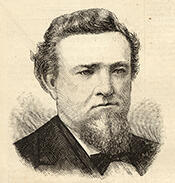
Alfred Moore Scales (November 26, 1827 – February 9, 1892) was a North Carolina lawyer, state legislator, Confederate general in the American Civil War, long‑serving Democratic member of the United States House of Representatives, and the 45th Governor of North Carolina. He was born at Reidsville, in Rockingham County, North Carolina, and spent his youth on Mulberry Island Plantation. After attending a Presbyterian school, he pursued further studies at the Caldwell Institute and then at the University of North Carolina at Chapel Hill, where he became a member of the Dialectic and Philanthropic Societies. Following a brief period as a teacher, he read law under Judge William H. Battle and Judge Thomas Settle and subsequently opened a law office in Madison, North Carolina, beginning a legal career that would underpin his later political and military prominence.
Scales entered public life early. In 1852 he was elected county solicitor of Rockingham County, and he was later elected four times to the North Carolina state legislature, where he rose to chair the Finance Committee. In 1854 he ran as the Democratic candidate for the United States Congress in a predominantly Whig district, losing by a narrow margin. He remained active in state affairs and, from 1858 until the spring of 1861, held the office of clerk and master of the court of equity of Rockingham County. In the presidential election of 1860 he served as an elector for the Southern Democratic ticket headed by John C. Breckinridge and became involved in the intense debates over North Carolina’s possible secession from the Union, positioning himself among those who would soon support the Confederate cause.
With the outbreak of the Civil War, Scales entered Confederate service in North Carolina. Responding to the call for troops from Washington, he volunteered as a private but was immediately elected captain of Company H, 13th North Carolina Infantry Regiment. On November 14, 1862, he was elected to succeed William Dorsey Pender as colonel of the regiment. Serving throughout with General Robert E. Lee’s Army of Northern Virginia, he saw action in the Peninsula Campaign, including Yorktown and the Battle of Williamsburg, and in the Seven Days Battles near Richmond. After the Battle of Malvern Hill he collapsed from exhaustion and nearly died. Brigadier General Samuel Garland Jr. commended him in his official report for seizing the colors of his regiment at a critical moment at Cold Harbor and rallying his men, an act that helped restore confidence and maintain the line. His recovery kept him from participating in the Second Manassas and Antietam campaigns, but he returned in time to fight at Fredericksburg in December 1862, where he temporarily commanded the brigade after Pender was wounded, and at Chancellorsville in May 1863, where he was wounded in the thigh yet remained on the field until blood loss forced his withdrawal. During the winter of 1862–1863, the 35‑year‑old Scales married 18‑year‑old Kate Henderson of Gaston County, North Carolina, beginning a family life later remembered as notably harmonious.
Scales was promoted to brigadier general on June 13, 1863, while recuperating at home, and on his return to duty he was assigned command of Pender’s former brigade. On July 1, 1863, during the first day of the Battle of Gettysburg, his brigade’s attack with Pender’s Division helped open the way for Abner M. Perrin’s brigade to break the Union line on Seminary Ridge and drive Federal forces back toward Cemetery Hill. In this assault Scales’s Brigade suffered devastating losses; he fought with conspicuous gallantry and was severely wounded in the leg by a shell fragment. Nearly every field officer in the brigade was killed or wounded, and the unit, already reduced by earlier fighting at Chancellorsville, lost almost 550 of the approximately 1,350 men engaged. On July 2 the brigade was engaged mainly in skirmishing, but on July 3, still understrength and with Scales incapacitated, it took part in Pickett’s Charge under the immediate command of Colonel William Lee J. Lowrance, advancing among the Confederate units that penetrated farthest into the Union position. Scales, evacuated with the also‑wounded Pender, was carried back to Virginia in an ambulance and left at Winchester to recover; Pender died of his wounds, but Scales eventually returned to service.
Despite lingering effects from his Gettysburg wound, Scales resumed command and participated in the 1864 campaigns of the Army of Northern Virginia, including the Battles of the Wilderness and Spotsylvania Court House and the Siege of Petersburg. His health, however, remained impaired, and he ultimately took a leave of absence late in the war. He was at home in North Carolina when Lee surrendered at Appomattox Court House in April 1865. There is no record that he was formally paroled, but he applied for amnesty at Raleigh on June 22, 1865, and received a presidential pardon on June 18, 1866. After the war, Scales returned to the practice of law in North Carolina, where he again achieved distinction at the bar and re‑entered political life as a Democrat during Reconstruction and the post‑Reconstruction era.
Scales’s national legislative career spanned much of the later nineteenth century. He was first elected to the United States House of Representatives as a Democrat from North Carolina in 1857, serving in the Thirty‑fifth Congress. Although defeated for re‑election in 1859, his early service in Congress placed him at the center of the mounting sectional tensions that preceded the Civil War. After resuming his legal and political activities in the postwar period, he was elected again to Congress in 1874, taking his seat in the Forty‑fourth Congress on March 4, 1875. He was re‑elected to four succeeding Congresses, serving continuously until March 3, 1885. In total, Alfred Moore Scales served six terms in the United States House of Representatives between 1857 and 1885. As a member of the Democratic Party, he contributed to the legislative process during a significant period in American history, participating in the democratic governance of the Reconstruction and post‑Reconstruction eras and representing the interests of his North Carolina constituents in debates over economic policy, federal‑state relations, and the political reintegration of the South.
In 1884 Scales was elected Governor of North Carolina and assumed office as the state’s 45th governor on January 21, 1885. He served one four‑year term, leaving office in 1889 after overseeing a period of political consolidation by Democrats and continued economic development in the state. His majority in the 1884 election exceeded twenty thousand votes, reflecting his personal popularity and the strength of his party. Upon the expiration of his term in 1888 (with his successor inaugurated in early 1889), he retired permanently from elective politics, repeatedly declining entreaties to seek another seat in Congress. That same year he became president of the Piedmont Bank in Greensboro, North Carolina, a position he held until his death. His former law office in Madison, the Alfred Moore Scales Law Office, was later recognized for its historical significance and listed on the National Register of Historic Places in 1982.
Scales’s health deteriorated after he left the governorship. He suffered from Bright’s disease, a chronic kidney ailment that progressively affected his overall condition and, in time, his mental clarity. During the final months of his life he was reportedly conscious only for brief intervals. Alfred Moore Scales died in Greensboro, North Carolina, on February 9, 1892, and was buried in Green Hill Cemetery there. At his death, businesses in Greensboro closed and the city’s residents turned out en masse to attend his funeral, a testament to the esteem in which he was held. He was survived by his wife, Kate Henderson Scales, and their daughter, Mrs. John Noble Wyllie. Contemporaries and later historians, including Douglas Southall Freeman, regarded him as a gallant soldier and capable leader; Freeman noted that among the eight officers promoted to brigadier general after Chancellorsville, Scales’s advancement was “a matter of course,” reflecting the high regard in which he was held both in war and in peace.
Congressional Record