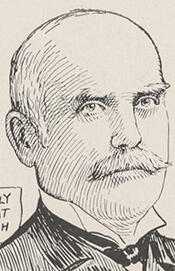
Alfred Lucking (December 18, 1856 – December 1, 1929) was an American lawyer and Democratic politician from the U.S. state of Michigan who served one term as a United States Representative and later became general counsel for the Ford Motor Company and the Henry Ford interests. He was born in Ingersoll in the Province of Canada to Joseph Alfred Lucking and Margaret Ellen Ford. In 1858 he moved with his parents to Ypsilanti, Michigan, where he was raised and began his education. He attended the public schools of Ypsilanti, Ypsilanti High School, and the Michigan State Normal College (now Eastern Michigan University), laying the foundation for a career in law and public service.
Lucking pursued legal studies at the University of Michigan Law School in Ann Arbor, from which he graduated in 1878. That same year he was admitted to the bar and commenced the practice of law in Jackson, Michigan. On February 23, 1881, he married Sarah Laviah Rose; the couple had two sons, William A. Lucking and Dean L. Lucking. In 1880 he moved to Detroit, Michigan, where he continued to build a substantial legal practice. Over the ensuing decades he became a prominent figure in the city’s legal and political circles, recognized for his advocacy skills and his growing influence within the Democratic Party.
Lucking’s political career developed in tandem with his legal work. A committed Democrat, he emerged as a party leader at the state level at the turn of the twentieth century. He served as temporary chairman of the Michigan Democratic State Convention in 1900, and he was both temporary and permanent chairman of the state conventions in 1902, 1908, and 1924. He again served as permanent chairman in 1928. These roles reflected his stature as a key organizer and spokesman for Michigan Democrats during a period of significant political realignment and industrial growth in the state.
In 1902, Lucking was elected as a Democrat from Michigan’s 1st congressional district to the Fifty-eighth Congress, defeating incumbent Republican John Blaisdell Corliss. He served as a Representative from Michigan in the United States Congress from March 4, 1903, to March 3, 1905. His single term in the House of Representatives occurred during a significant period in American history marked by rapid industrialization and the early Progressive Era. As a member of the House of Representatives, Alfred Lucking participated in the legislative process, represented the interests of his Detroit-area constituents, and contributed to the democratic process during his one term in office. A member of the Democratic Party, he worked within a Republican-dominated political environment, which shaped both his legislative opportunities and challenges.
Lucking was an unsuccessful candidate for re-election in 1904 to the Fifty-ninth Congress and returned to Detroit to resume the practice of law. His political ambitions continued, and in 1912 he sought election to the United States Senate, though he was again unsuccessful. Despite these electoral defeats, he remained an influential figure in Michigan Democratic politics, as evidenced by his repeated selection to preside over state party conventions and his role as a delegate to the 1924 Democratic National Convention.
Parallel to his political activities, Lucking’s legal career reached national prominence through his association with Henry Ford. From 1914 to 1923 he served as general counsel for the Ford Motor Company and the Henry Ford interests, acting as industrialist Henry Ford’s personal attorney. In this capacity he was involved in legal matters arising from the rapid expansion of Ford’s automotive enterprises and the broader business affairs of Henry Ford. He also served as president of the Detroit-Vancouver Timber Company, extending his influence into the field of natural resources and corporate management.
Alfred Lucking died in Detroit on December 1, 1929, just before his seventy-third birthday. He was interred at Woodlawn Cemetery in Detroit. His life encompassed significant roles as a lawyer, congressman, party leader, and corporate counsel during a transformative era in Michigan and American history.
Congressional Record