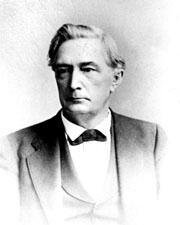
Alfred Holt Colquitt (April 20, 1824 – March 26, 1894) was an American lawyer, preacher, soldier, and Democratic politician who served Georgia as a United States Representative, governor, and United States Senator. Elected as the 49th governor of Georgia from 1877 to 1882, he was among the Democrats who regained control of Southern state governments as white conservatives reasserted power at the end of the Reconstruction era. He was later elected by the Georgia General Assembly to two terms in the United States Senate, serving from 1883 until his death in 1894, and he died in office. Over the course of his public life he also served as a United States Army officer in the Mexican–American War and as a Confederate major general during the American Civil War.
Colquitt was born in Monroe, Walton County, Georgia, the son of Walter T. Colquitt, a prominent lawyer, Methodist preacher, and politician who served as both a United States Representative and a United States Senator from Georgia. Raised in a politically active and religious household, Alfred Colquitt received a classical education and attended Princeton College (now Princeton University), from which he graduated in 1844. After college he studied law, was admitted to the bar in 1846, and began practicing in Monroe. Influenced by his father’s religious commitments, he also became known as a lay preacher in the Methodist tradition, combining legal practice with religious and civic engagement in his early adulthood.
With the outbreak of the Mexican–American War, Colquitt entered national service. From 1848 to 1849 he served as a paymaster in the United States Army with the rank of major, gaining administrative and military experience that would shape his later career. Returning to Georgia after the war, he resumed the practice of law and entered politics. A Democrat, he was elected to the United States House of Representatives and served one term from March 4, 1853, to March 3, 1855. After leaving Congress he served in the Georgia state legislature, further entrenching himself in state politics. He was chosen as a presidential elector in 1860, participating in the fractious national contest that immediately preceded secession and civil war.
As sectional tensions escalated, Colquitt emerged as a supporter of secession. He was a delegate to the Georgia Secession Convention of 1861, where he voted in favor of leaving the Union and signed Georgia’s Ordinance of Secession on January 19, 1861. At the beginning of the Civil War he entered Confederate service as a captain in the 6th Georgia Infantry. He rose to colonel and led his regiment during the Peninsula Campaign in Virginia. At the Battle of Seven Pines he assumed command of a brigade after Brigadier General Gabriel J. Rains was wounded, and he led that brigade through the subsequent Seven Days Battles. Serving under Thomas J. “Stonewall” Jackson, Colquitt commanded his brigade in major engagements including the Battle of South Mountain, the Battle of Antietam, the Battle of Fredericksburg, and the Battle of Chancellorsville. At Antietam he survived unscathed despite heavy casualties among his officers, and he was promoted to brigadier general, with rank from September 1, 1862. By the end of the war he had attained the rank of major general in the Confederate States Army.
Colquitt’s Civil War service took him across several theaters. After Chancellorsville, questions were raised about his performance in that battle, and his brigade was transferred to North Carolina in exchange for Brigadier General Junius Daniel’s brigade. In the summer of 1863 his command was moved again to help defend Charleston, South Carolina, a critical Confederate port. In February 1864 he marched his brigade to Florida to oppose a Union invasion and played a leading role in the Confederate victory at the Battle of Olustee, the largest Civil War engagement fought in that state. Following Olustee, his brigade rejoined General Robert E. Lee’s Army of Northern Virginia. Late in the war Colquitt’s troops returned to North Carolina, where he ultimately surrendered in 1865 as the Confederacy collapsed.
After the war Colquitt returned to Georgia and resumed his legal and political career amid the turbulent Reconstruction era. Aligning with the Democratic Party and the emerging “Redeemer” movement of white conservatives, he became a leading figure in efforts to restore Democratic control of state government. In 1876 he was elected governor of Georgia and took office in 1877 as the state’s 49th governor. His administration coincided with the formal end of Reconstruction and the withdrawal of federal troops from the South. As governor from 1877 to 1882, he presided over efforts to reduce state debt, promote railroad and industrial development, and encourage agricultural recovery, while also overseeing and benefiting from the reestablishment of white Democratic dominance and the erosion of many of the political gains that African Americans had made during Reconstruction.
At the conclusion of his gubernatorial service, Colquitt was chosen by the Georgia General Assembly to represent the state in the United States Senate. A member of the Democratic Party, he was elected to two terms and served as a Senator from Georgia from 1883 to 1894. His tenure in the Senate occurred during a significant period in American history marked by rapid industrialization, debates over tariffs and monetary policy, and the entrenchment of Jim Crow in the South. During three terms in federal office over the course of his career—one in the House of Representatives in the 1850s and two in the Senate in the 1880s and 1890s—Colquitt participated in the legislative process and represented the interests of his Georgia constituents in Washington, D.C., contributing to national discussions on economic and regional issues.
Colquitt continued to serve in the Senate until his death. He died in office on March 26, 1894, in Washington, D.C. His passing placed him among the members of the United States Congress who died while still serving between 1790 and 1899. Colquitt was later commemorated in Georgia through historical markers, memorial addresses delivered in Congress, and continued scholarly interest in his role as a Confederate general, Redeemer-era governor, and long-serving Democratic senator from Georgia.
Congressional Record