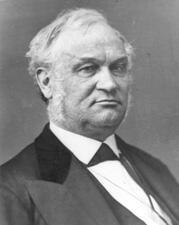
Alexander Ramsey (September 8, 1815 – April 22, 1903) was an American politician who became the first Minnesota Territorial Governor and later a United States Senator from Minnesota. He served as a Whig and, later, as a Republican over a variety of offices between the 1840s and the 1880s, and his congressional service occurred during a significant period in American history. Counties, towns, parks, and schools were later named in his honor, including Ramsey County, Minnesota; Ramsey County, North Dakota; the cities of Ramsey, Minnesota, and Ramsey, Illinois; Alexander Ramsey Park in Redwood Falls, Minnesota; and Ramsey Park in Stillwater, Minnesota. He was also the namesake of the Liberty Ship SS Alexander Ramsey, launched in 1942.
Ramsey was born near Harrisburg, Dauphin County, Pennsylvania, and was of Scots-Irish descent. Orphaned as a child, he was apprenticed to a carpenter before pursuing formal education. He attended Lafayette College in Easton, Pennsylvania, where he studied law, and was admitted to the bar in 1839. He began practicing law in Harrisburg and quickly became involved in Whig Party politics, building a reputation as an effective organizer and public speaker in Pennsylvania’s political circles.
Ramsey’s national political career began in the House of Representatives. He was elected as a Whig to the Twenty-eighth and Twenty-ninth Congresses and served as a Representative from Pennsylvania from March 4, 1843, to March 3, 1847. During these years he participated in the legislative process in the lower chamber, representing the interests of his constituents at a time marked by debates over territorial expansion and economic policy. After leaving the House, he continued to be active in public affairs and was appointed by President Zachary Taylor as the first governor of the newly created Minnesota Territory.
As the first Minnesota Territorial Governor, Ramsey served from 1849 to 1853, overseeing the early organization of territorial government, the establishment of administrative structures, and the promotion of settlement and development. He played a central role in negotiating treaties with Native American nations that opened large areas of land to white settlement, actions that would have profound and often devastating consequences for Indigenous communities. After his territorial governorship, he remained in Minnesota, where he became a leading figure in the emerging Republican Party and helped guide the territory toward statehood.
Ramsey was elected the second governor of the State of Minnesota and served from 1860 to 1863. His tenure as state governor coincided with the Civil War and the Dakota War of 1862. Ramsey called for the killing or removal of the Mdewakanton and Wahpekute Dakota from the state of Minnesota during this conflict. After pressing the Dakota to sell their land, he and other officials stole from the Dakota’s annuities. In response, some of the Dakota attacked American settlements, resulting in the death of at least 800 civilian men, women, and children, and the displacement of thousands more. When the Fond du Lac band of Chippewa learned of the uprising, they sent a letter to Ramsey to forward to President Abraham Lincoln, dated September 6, 1862, offering to fight the Sioux. On September 9, 1862, Ramsey addressed the state legislature and proclaimed, “The Sioux Indians of Minnesota must be exterminated or driven forever beyond the borders of the State,” which he justified by citing various outrages against settlers and alleged violations of treaties. In northern Minnesota, the Chippewa/Ojibwa were having problems with their Indian agent stealing from them. Governor Ramsey led a legislative commission to the Crow Wing agency to address their issues. There, ten chiefs of the Leech Lake and Mississippi bands laid out their concerns and offered to fight the Sioux for the government. The commission approved their offer in principle, and Ramsey invited the leaders of twenty-two bands of Ojibwa to St. Paul. They arrived on September 23 waving the American flag, believing their offers had been accepted. Ramsey then had to inform them that Major General John Pope would not accept their service on the grounds that it would not be good public policy, though they would be contacted if needed. In 1863, in response to continued raids on settlers, Ramsey authorized a bounty for the scalps of Dakota males.
Ramsey’s service in Congress extended beyond his earlier House career to a long tenure in the United States Senate. A member of the Republican Party by this time, he served as a Senator from Minnesota in the United States Congress from 1843 to 1875, contributing to the legislative process during four terms in office. In fact, his Senate service, which followed his state governorship, ran from March 4, 1863, to March 3, 1875. As a member of the Senate, Ramsey participated in the democratic process and represented the interests of his Minnesota constituents during the Civil War, Reconstruction, and the early years of western expansion. He served on key committees, including those dealing with military affairs and territories, and was involved in legislation affecting railroads, public lands, and the ongoing relationship between the federal government and Native American nations.
After leaving the Senate in 1875, Ramsey remained active in national public service. President Rutherford B. Hayes appointed him Secretary of War, and he served in that capacity from December 10, 1879, to March 5, 1881. In this role he oversaw aspects of the post–Civil War Army during a period of continued western military campaigns and institutional reform. He later served as chairman of the United States Tariff Commission in the early 1880s, reflecting his continued engagement with national economic policy. Throughout these later appointments, he maintained his prominence as a Republican elder statesman and a symbol, for many contemporaries, of Minnesota’s political development, even as his record on Native American policy has been the subject of significant historical criticism.
In his later years, Ramsey lived in St. Paul, Minnesota, where he remained a respected, if controversial, public figure. Educational institutions were named after him, including Alexander Ramsey Elementary School in Montevideo, Minnesota, and several schools in the Twin Cities that later changed their names in response to reassessments of his legacy. Hidden River Middle School in Saint Paul was formerly named after him; during the 2021–2022 school year, the school was renamed after approval from the St. Paul School Board, following staff and student calls for a name change in the spring of 2021. Justice Page Middle School in Minneapolis was originally named for him when founded in 1932 (as Ramsey International Fine Arts Center and formerly Alexander Ramsey Junior High School), but a student-initiated effort in the 2016–2017 school year led to its renaming in honor of Alan Page, the first African American justice of the Minnesota Supreme Court. Alexander Ramsey died in St. Paul on April 22, 1903, and was interred in Oakland Cemetery, leaving a complex legacy marked by his central role in Minnesota’s political formation and his deeply consequential actions toward Native American communities.
Congressional Record