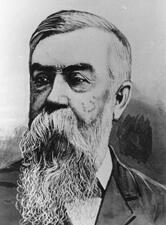
Alexander Caldwell (March 1, 1830 – May 19, 1917) was a Republican politician, businessman, and banker who represented Kansas in the United States Senate from 1871 to 1873. His brief congressional service occurred during a significant period in American history, as the nation continued to grapple with the political and economic aftermath of the Civil War and the challenges of Reconstruction. During his single term in office, he participated in the legislative process and represented the interests of his Kansas constituents in the Senate.
Caldwell was born on March 1, 1830, in Drakes Ferry, Pennsylvania. He attended the local public schools and entered adulthood at a time of national expansion and conflict. In 1847, during the Mexican–American War, he enlisted as a private, gaining early exposure to military service and the operations of the federal government in wartime. After his service, in 1848 he moved to Columbia, Pennsylvania, where he was employed in a bank. This early experience in finance provided him with a foundation in business and commerce, and he subsequently went into business for himself, beginning a career that would combine entrepreneurship with public service.
In 1861, as the Civil War began, Caldwell moved west to Leavenworth, Kansas, a key military and commercial center on the frontier. There he engaged in the transportation of military supplies to various posts on the plains, contributing to the Union war effort and the logistical support of western forts. After the war, he expanded his business activities into railroad construction, working particularly on the Missouri River and Kansas Central Railroad. His involvement in transportation and railroads reflected the broader national push toward internal improvements and westward development, and it helped establish his prominence in Kansas economic life.
Caldwell entered national politics as a member of the Republican Party, which dominated Kansas politics in the post–Civil War era. He was elected as a Republican to the United States Senate and took his seat on March 4, 1871, representing Kansas in the Forty-second and Forty-third Congresses. His service in Congress coincided with ongoing debates over Reconstruction policy, western expansion, and economic development, and he participated in the democratic process as a senator during this transformative period. However, his tenure was overshadowed by controversy. After just two years in office, Caldwell resigned his seat on March 24, 1873, in the face of a strong movement to expel him from the Senate on charges of bribery and corruption. It was alleged that he had bribed political opponents not to run for the Senate, thereby clearing the field for his own election in 1871. Thomas Carney, a senatorial candidate and former governor of Kansas, admitted that he had accepted $15,000 from Caldwell to withdraw from the race, a revelation that became central to the scandal and placed Caldwell among the notable figures in the history of federal political scandals in the United States.
After leaving the Senate, Caldwell returned to private enterprise and rebuilt his career in business. From 1877 to 1897, he engaged in the manufacture of wagons and carriages, an industry closely tied to the transportation needs of a rapidly expanding nation. His business interests extended beyond Kansas: in the 1880s, he served as president of the Idaho and Oregon Land Improvement Company, which acquired acreage adjacent to the tracks of the Oregon Short Line Railroad in the Pacific Northwest. The city of Caldwell in southwestern Idaho was named in his honor, reflecting his influence in regional development and railroad-related land promotion during that era.
Caldwell’s later years were marked by continued prominence in finance and local economic affairs. From 1897 to 1915, he served as president of the First National Bank of Leavenworth, consolidating his long association with that city and with the banking industry that had first shaped his early career in Pennsylvania. Under his leadership, the bank participated in the commercial life of Leavenworth during a period of significant economic change at the turn of the twentieth century. He remained a notable figure in Kansas business circles well into his eighties.
Alexander Caldwell died on May 19, 1917, in Kansas City, Missouri. He was interred at Mount Muncie Cemetery in Leavenworth, Kansas, a community that had been central to his business, political, and financial endeavors. His life reflected the opportunities and controversies of the Gilded Age, spanning military service in the Mexican–American War, frontier commerce and railroad building, a brief but turbulent term in the United States Senate, and a long career in manufacturing and banking on the Great Plains and in the developing West.
Congressional Record