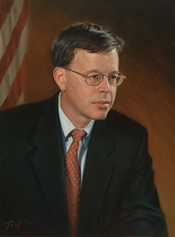
Alexander Buckner (March 8, 1785 – June 6, 1833) was a United States senator from Missouri and an influential early political leader in both Indiana and Missouri during the formative years of the American frontier. Born in Jefferson County, Kentucky, he came of age in a region that was then part of the expanding western frontier of the young United States. Details of his early family life are sparse, but his subsequent professional and political career indicate that he received a legal education sufficient to qualify him for admission to the bar and for public legal office.
Buckner studied law in Kentucky and, seeking opportunity in the developing territories of the Old Northwest, moved to Charlestown, Indiana, in 1812. There he established himself as a practicing attorney and became active in civic and fraternal affairs. He was instrumental in the founding of the Grand Lodge of Indiana and, reflecting his prominence and leadership in the Masonic community, served as the first Grand Master of Masons in Indiana in 1818. His legal training and organizational leadership during this period laid the groundwork for his later political influence in Missouri.
In 1818 Buckner relocated again, this time to the Missouri Territory, settling near Jackson in what would become Cape Girardeau County. He continued the practice of law and also engaged in agricultural pursuits, combining a professional legal career with the management of a farm, as was common among frontier elites of the era. Recognized for his legal abilities, he was appointed by the territorial governor as circuit attorney for the Cape Girardeau district, a position that placed him at the center of the territory’s judicial system. His stature in Missouri politics rose rapidly, and in 1820 he served as president of the Missouri state constitutional convention, presiding over the body that framed the state’s first constitution as Missouri prepared for admission to the Union.
Following statehood, Buckner continued his public service in the new state government. He was elected to the Missouri Senate, in which he served from 1822 to 1826. As a state senator, he participated in shaping the legal and political institutions of Missouri during its earliest years as a state. His legislative work at the state level, combined with his earlier constitutional leadership, established him as a prominent figure in Missouri’s Democratic, or Jacksonian, political circles.
Buckner’s state-level prominence led to his election to the United States Senate as a member of the Jackson Party representing Missouri. He took his seat in the U.S. Senate on March 4, 1831, during a significant period in American history marked by the presidency of Andrew Jackson and intense national debates over federal power, economic policy, and westward expansion. Serving one term in office until his death in 1833, he contributed to the legislative process and participated in the democratic governance of the nation, representing the interests of his Missouri constituents in the upper chamber of Congress. His service placed him among the early generation of senators from the trans-Mississippi West, helping to give voice to the concerns of a rapidly growing frontier state.
Buckner’s congressional service was cut short when he died in office on June 6, 1833, in Cape Girardeau County, Missouri, during a cholera outbreak. His death placed him among the members of the United States Congress who died in office in the nineteenth century. He was initially interred on his farm in Cape Girardeau County, reflecting the common practice of family burials on private land in rural areas at the time. In 1897, his remains were reinterred in City Cemetery in Cape Girardeau, Missouri, a move that underscored his lasting significance in the history of the region and the state.
Congressional Record