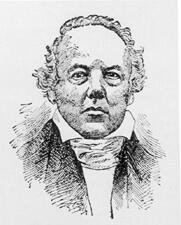
Albion Keith Parris (January 19, 1788 – February 11, 1857) was the fifth governor of Maine, a United States representative from the District of Maine when it formed part of Massachusetts, a United States senator from Maine, a United States district judge of the United States District Court for the District of Maine, an associate justice of the Maine Supreme Judicial Court, and the 2nd Comptroller of the Currency for the United States Department of the Treasury. He was born on January 19, 1788, in Hebron, in the District of Maine, then a part of the Commonwealth of Massachusetts. Parris was a cousin of Virgil D. Parris, who later served as a United States representative from Maine, reflecting the family’s broader engagement in public life.
Parris pursued higher education at Dartmouth College in Hanover, New Hampshire, from which he graduated in 1806. He then read law and completed his legal preparation in 1809. Admitted to the bar shortly thereafter, he commenced private practice in Paris, in the District of Maine, where he practiced from 1810 to 1811. His early legal work in this rural but politically active region helped establish his reputation as a capable attorney and positioned him for rapid entry into public office.
Parris’s public career began at the county and state levels. He served as prosecutor for Oxford County in the District of Maine from 1811 to 1813, a role in which he was responsible for conducting criminal prosecutions on behalf of the government. He then entered legislative service as a member of the Massachusetts House of Representatives from Paris, District of Maine, serving from 1813 to 1814. Continuing his rise in state politics, he was elected to the Massachusetts Senate from Oxford and Somerset Counties in the District of Maine and served there from 1814 to 1815, participating in the governance of Massachusetts at a time when the District of Maine was increasingly seeking separate statehood.
Parris advanced to the national stage when he was elected as a Democratic-Republican to the United States House of Representatives from Massachusetts’s 20th congressional district, representing the District of Maine. He served in the 14th and 15th Congresses from March 4, 1815, to February 3, 1818. During this period, which coincided with the post–War of 1812 era and the early “Era of Good Feelings,” he contributed to the legislative process in the House of Representatives. He resigned his House seat on February 3, 1818, to accept a federal judicial appointment. In 1819 he further contributed to the formation of the future state by serving as a delegate to the Maine constitutional convention, which framed the constitution under which Maine entered the Union.
On January 27, 1818, President James Monroe nominated Parris to the United States District Court for the District of Maine, to the seat vacated by Judge David Sewall. He was confirmed by the United States Senate on January 28, 1818, and received his commission the same day. He served as a United States district judge until his resignation on January 1, 1822. Concurrently with his federal judicial service, Parris also served as Judge of the Cumberland County Probate Court from 1820 to 1821. During his tenure on the federal bench, the District of Maine was admitted to the Union as the State of Maine on March 15, 1820, a transition that reshaped the jurisdiction in which he sat and underscored his role in a formative period of the new state’s legal and political development.
Following his judicial service, Parris entered the executive branch of Maine’s state government. He was elected the fifth governor of Maine and served from 1822 to 1827. As governor, he presided over the early years of Maine’s statehood, helping to establish state institutions and policies in the wake of separation from Massachusetts. After his gubernatorial tenure, he was elected as a member of the Jackson Party to the United States Senate from Maine. Albion Keith Parris served as a senator from Maine in the United States Congress from March 4, 1827, to August 26, 1828. A member of the Jackson Party, he contributed to the legislative process during his service in the Senate and represented the interests of his constituents during a significant period in American political realignment. His service in Congress occurred during a notable era in American history, as the emerging Jacksonian movement reshaped national politics. He resigned his Senate seat on August 26, 1828.
Parris continued his judicial and administrative career after leaving the Senate. He became an associate justice of the Maine Supreme Judicial Court in 1828 and served on that court until 1836, participating in the development of Maine’s jurisprudence during its first decades as a state. In 1836 he was appointed the 2nd Comptroller of the Currency for the United States Department of the Treasury, a senior financial oversight position within the federal government. He held that post from 1836 to 1850, overseeing aspects of federal fiscal administration during a period marked by financial instability, including the aftermath of the Panic of 1837. In the fall of 1846, while still engaged in federal service, Parris also served as one of three commissioners negotiating a treaty at Washington, D.C., with the Winnebago (Ho-Chunk) Indians, reflecting his involvement in federal Indian affairs and treaty-making.
After leaving the Treasury Department, Parris resumed private legal practice in Portland, Maine, from 1849 to 1852. He also remained active in local politics and civic life. In 1852 he was elected Mayor of Portland, further extending his long record of public service at the municipal level. He continued to seek higher office and was the unsuccessful Democratic candidate for governor of Maine in 1854, losing to Know Nothing candidate Anson Morrill, an outcome that reflected the shifting political currents of the 1850s. Parris Street in Portland was later named in his honor, commemorating his long association with the city and his prominence in Maine’s public affairs.
Albion Keith Parris died on February 11, 1857, in Portland, Maine. He was interred in Evergreen Cemetery in Portland. His career, spanning local, state, and federal offices in legislative, executive, and judicial branches, as well as significant financial and diplomatic responsibilities, made him a central figure in the political and legal history of Maine and the early decades of the United States.
Congressional Record