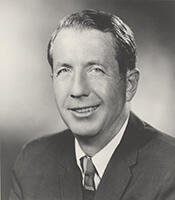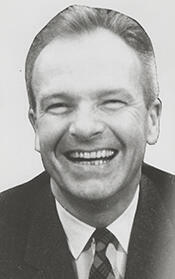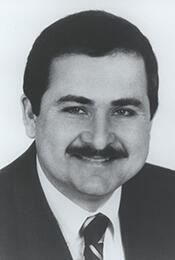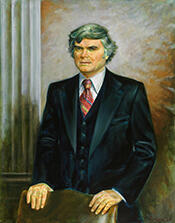
Albert Conrad Ullman (March 9, 1914 – October 11, 1986) was an American politician in the Democratic Party who represented Oregon’s 2nd congressional district in the United States House of Representatives from 1957 to 1981. Serving twelve consecutive terms, he became one of the most influential Oregonians ever elected to Congress, along with Senator Wayne Morse, and rose to preside over the powerful House Committee on Ways and Means. Over the course of his long tenure, Ullman played a central role in shaping national policy on taxation, budget reform, federal entitlement programs, international trade, energy, and the development and management of natural resources in the Pacific Northwest.
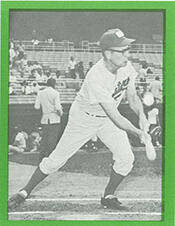
Ullman was born in Great Falls, Montana, and was raised initially in Gildford, Montana. His family later moved to Cathcart, near Snohomish, Washington, where his father operated a small country grocery store. He was the grandson of immigrants, with two grandparents from Germany and two from Bohemia, then part of the Austro-Hungarian Empire, a background that informed his appreciation for American civic institutions. In 1935, he graduated from Whitman College in Walla Walla, Washington, with a degree in political science; while there he played football as a running end. After college, he taught American history and government at Port Angeles High School in Port Angeles, Washington, for two years, gaining early experience in public affairs and civic education.
Pursuing advanced study in government and law, Ullman earned a master’s degree in public law from Columbia University in 1939. With the onset of World War II, he entered military service and from 1942 to 1945 served as a communications officer with the United States Navy in the South Pacific. Following the war, Ullman settled in Baker, Oregon (now Baker City), where he taught himself how to design and build houses and worked as a builder and real estate developer in the late 1940s and early 1950s. His business activities and community involvement in eastern Oregon helped establish the local ties that would later underpin his political career.
Ullman first sought election to Congress in 1954, running as a Democrat in Oregon’s 2nd congressional district. In a year generally favorable to Democrats in Oregon, he narrowly lost to the incumbent Republican, Sam Coon, after the revival of a two-year-old allegation of a violation of the Real Estate Code, which even the Republican-leaning Oregonian newspaper regarded as politically motivated. Undeterred, Ullman ran again in 1956 and defeated Coon, waging a populist campaign centered on public power issues and strongly opposing the transfer of hydroelectric development rights at Hells Canyon on the Snake River to private interests. Taking office on January 3, 1957, he began what would become a 24-year career in the House of Representatives, during which he consistently represented the interests of his largely rural and geographically expansive constituency.
As a member of the House of Representatives, Ullman represented one of the largest congressional districts in the nation that did not encompass an entire state. Oregon’s 2nd district stretched from the state capital of Salem eastward to the Idaho border, covering roughly 70,000 square miles—an area larger than any state east of the Mississippi River—and including alpine forests, rangeland, and desert. Throughout his service, he devoted particular attention to the development of Oregon’s water resources, the management of public lands and national forests, and the broader economic needs of the Pacific Northwest. He emerged as a de facto regional leader, working closely with figures such as Senator Henry “Scoop” Jackson and Representative (later Speaker) Tom Foley of Washington, and he became well known for his longstanding advocacy on behalf of American Indian tribes in Eastern Oregon, whom he believed had been treated unjustly by the federal government in matters of treaties, land, and other rights.
Over the course of his congressional career, Ullman served on a wide range of committees and commissions that reflected both his regional interests and his growing national influence. Early on, he served on the House Committee on Interior and Insular Affairs (now the House Committee on Natural Resources) and on the House Committee on the Judiciary. He was appointed to the National Outdoor Recreation Resources Review Commission, where he contributed to policy discussions on public lands and recreation. As his expertise in fiscal matters deepened, he became increasingly involved in budgetary and tax policy. From 1972 to 1974 he co-chaired the Joint Study Committee on Budget Control, and in 1974 he served as the first chairman of the newly created House Committee on the Budget. He also played a role in internal party governance through service on the Democratic Committee on Committees.
For most of his time in Congress, Ullman was regarded as a moderate Democrat, but he became nationally prominent as an architect of modern federal budget procedures and tax policy. He is widely considered one of the principal founders of the present-day United States budget process. The work of the Joint Study Committee on Budget Control, which he initiated and later co-chaired beginning in 1973, led to major budget reforms that, for the first time, required Congress to reconcile federal spending with revenues in a systematic way in order to address mounting deficits. His leadership as chair of the House Budget Committee in 1974 helped institutionalize these reforms. Ullman had served on the House Ways and Means Committee since 1961, and from 1973 to 1975 he acted as its de facto leader before formally becoming chairman in 1975. From 1975 to 1981 he chaired Ways and Means and simultaneously served as co-chairman of the Joint Committee on Taxation, placing him at the center of legislative efforts on taxation, Social Security, trade, and energy policy.
As chairman of the Ways and Means Committee, Ullman oversaw the drafting and passage of numerous major tax measures. Among his most notable actions was sponsorship of sweeping tax-cut legislation in 1975 designed to stimulate the economy during a period of recession. The bill provided more than $20 billion in income tax rebates to Americans in the spring of 1975, an initiative that brought Ullman national recognition after nearly two decades of relatively low-profile service. He also played a central role in the enactment of the Crude Oil Windfall Profit Tax Act of 1980 (P.L. 96-223), which redirected an estimated $79 billion of oil company profits resulting from price deregulation toward support for mass transit, energy assistance for low-income households, and the development of alternative energy sources. Throughout his chairmanship, he remained deeply involved in questions of entitlement reform, trade policy, and the long-term structure of the federal tax system, including his controversial advocacy of a value-added tax as a partial alternative to what he regarded as inequities in the existing federal income tax.
Ullman’s congressional service came to an end in the 1980 elections. In the midst of the “Reagan landslide,” which saw the defeat of President Jimmy Carter and a Republican takeover of the United States Senate, Ullman narrowly lost his bid for a thirteenth term to Republican challenger Denny Smith. Observers attributed his defeat to a combination of factors: a strong national anti-incumbent and anti-government sentiment, the presence of an independent candidate in the race, the increasing conservatism of Oregon’s 2nd district, and controversy over his support for a value-added tax. Ullman and others also believed that President Carter’s early concession on election night, before the polls had closed in Oregon, discouraged turnout among Democratic-leaning voters and contributed to his loss.
After leaving Congress in 1981, Ullman remained in Washington, D.C., where he established Ullman Consultants, Inc., a consulting firm based in Georgetown that he operated with his wife, Audrey, and several former members of his congressional staff. That same year he donated his extensive congressional papers to the University of Oregon, preserving a detailed record of his work on budget and tax reform, natural resources, and regional development. In his later years he lived in Arlington, Virginia, and Falls Church, Virginia. Albert Conrad Ullman died of prostate cancer on October 11, 1986, leaving a legacy as a key figure in the evolution of the modern congressional budget process and as a leading advocate for Oregon’s interests in the mid-twentieth century.
Congressional Record