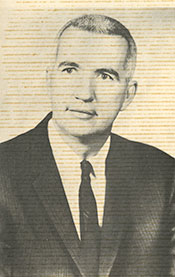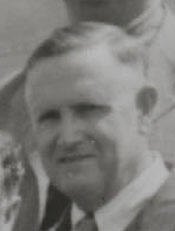
Albert Sidney Johnson Carnahan (January 9, 1897 – March 24, 1968) was an American educator, diplomat, and Democratic Party politician who represented southeastern Missouri in the United States House of Representatives for fourteen years between 1945 and 1961. A member of the Democratic Party, he served as a Representative from Missouri in the United States Congress for seven terms, contributing to the legislative process during a significant period in American history. He was the patriarch of the Carnahan family, a prominent political family in Missouri into the 21st century, and began his professional life as a teacher and school administrator.
Carnahan was born on January 9, 1897, on a farm near Ellsinore in Carter County, Missouri, the youngest of ten children. He was named after the Confederate General Albert Sidney Johnston. He attended Crommertown School, a one-room schoolhouse in Carter County, and grew up in a rural environment that shaped his later interest in public education and regional development. In 1914, at the age of seventeen, he began a career as an educator, teaching at Crommertown, Hogan Hollow, and Ellsinore, Missouri.
During World War I, Carnahan served for a year in an aviation unit of the United States Navy, stationed in Ireland. After his wartime service, he returned to Missouri and completed his high school education at the College High School in Cape Girardeau. He then pursued higher education at Missouri State Teachers College in Cape Girardeau, now Southeast Missouri State University, earning a bachelor’s degree in education in 1926. Carnahan taught in southeastern Missouri for several years before enrolling at the University of Missouri in Columbia, from which he received a master’s degree in 1932. Over the next several years he was a high school administrator in Carter, Reynolds, and Shannon counties, ultimately rising to the post of superintendent of schools in Ellsinore. During this period he married Kathel Schupp, with whom he raised two sons, Robert E. and Melvin E.
Carnahan entered national politics during World War II. In 1944, he was elected as a Democrat to represent Missouri’s 8th Congressional District in the U.S. House of Representatives. He took his seat in the 79th Congress in January 1945 and served one term before being defeated in the 1946 election. Undeterred, he ran again in 1948 and won, returning to Congress in 1949. He then served six additional consecutive terms, remaining in office until January 1961. Over the course of these seven terms, he represented the interests of his southeastern Missouri constituents during a transformative era that encompassed the end of World War II, the beginning of the Cold War, and the early years of the civil rights movement.
From his first term, Carnahan served on the House Committee on Foreign Affairs, a post that would define much of his congressional career. By the time of his retirement from Congress, he was the ranking member of that committee. He chaired the Subcommittee on International Organizations and Movements and the Subcommittee on Africa, positions that placed him at the center of debates over postwar reconstruction, decolonization, and the emerging architecture of international institutions. He helped write major legislation including the Servicemen’s Readjustment Act of 1944 (the GI Bill), the Marshall Plan for European recovery, the Area Development Act aimed at assisting economically distressed regions, and a revision of the Social Security statutes. Reflecting his engagement with international affairs, he was a delegate to the 12th General Assembly of the United Nations in 1957 and served as Congressional Advisor to the U.S. Delegation to the Second International Conference on the Peaceful Uses of Atomic Energy in Geneva in 1958.
Carnahan’s record in Congress also extended to civil rights and domestic policy. Representing a border state with complex racial and regional politics, he did not sign the 1956 Southern Manifesto, a document opposing the Supreme Court’s decision in Brown v. Board of Education. He voted in favor of the Civil Rights Act of 1957 and the Civil Rights Act of 1960, supporting incremental federal efforts to protect voting rights and strengthen civil rights enforcement. In 1960, he sought renomination for his House seat but failed to win the Democratic Party’s nomination, bringing his congressional service to a close in January 1961.
In 1961, President John F. Kennedy appointed Carnahan as the first United States Ambassador to Sierra Leone, following that country’s independence from British colonial rule. Drawing on his long experience on the House Committee on Foreign Affairs and his familiarity with African issues, he helped establish the initial framework of diplomatic relations between the United States and the new West African nation. He served in Freetown until 1963, when he retired from this diplomatic post and returned to private life.
After retiring from political life, Carnahan returned to Ellsinore, Missouri. He remained active in community and international service through the Rotary Club of Poplar Bluff, where he became Rotary District World Service Chairman. In that capacity he inaugurated a program to aid in the education of children in Sierra Leone, maintaining ties to the country where he had served as ambassador. Albert Sidney Johnson Carnahan died at the Mayo Clinic in Rochester, Minnesota, on March 24, 1968, and was buried at Carson Hill Cemetery in Ellsinore.
Carnahan was the first of three generations of his family to be elected to public office, and the Carnahans became one of the best known and most enduring political families in Missouri. His son Mel Carnahan served as Governor of Missouri from 1993 until his death in 2000. Mel’s wife, Jean Carnahan, was appointed to the United States Senate in 2001 following her husband’s posthumous election to that body. Carnahan’s grandson Russ Carnahan served in the U.S. House of Representatives from 2005 to 2013, and his granddaughter Robin Carnahan was Missouri Secretary of State from 2005 to 2013. In recognition of his contributions to education and public service, Carnahan Hall on the campus of Southeast Missouri State University, which houses the classes and offices of the Department of Political Science, was rededicated in his honor in 2004.
Congressional Record