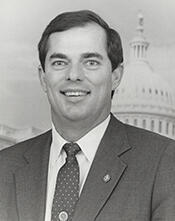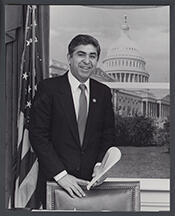
Albert Garza Bustamante (April 8, 1935 – November 30, 2021) was an American politician who served as a member of the United States House of Representatives from 1985 to 1993, representing Texas’s 23rd congressional district. A Democrat, he served four terms in Congress during a significant period in American political history, contributing to the legislative process and representing a vast, largely Hispanic constituency stretching across West Texas. He was also a member and one-time chair of the Congressional Hispanic Caucus, reflecting his prominence among Hispanic and Latino lawmakers at the federal level.
Bustamante was born and raised in Asherton, Texas, to a family of Mexican migrant workers, an upbringing that shaped his later focus on issues affecting working-class and Hispanic communities. After graduating from high school, he enlisted in the United States Army, serving for two years as a paratrooper. Following his military service, he pursued higher education, enrolling in San Antonio College in 1958 and earning an associate degree. He continued his studies at Sul Ross State University, where he received a Bachelor of Arts degree in education. After completing his degree, Bustamante began his professional career as a teacher at Cooper Junior High School in San Antonio, Texas.
Bustamante’s entry into public service began in 1968, when he became an aide to Congressman Henry B. González, a leading Texas Democrat and influential figure in San Antonio politics. This experience introduced him to legislative work and constituent service at the federal level. In 1972, Bustamante ran for elective office for the first time and was elected as a Bexar County Commissioner in Texas. He continued to build his local political career and, in 1978, was elected Bexar County judge, a powerful countywide executive and judicial position. In that role, he also served on the state’s Jail Standard Commission, gaining experience in criminal justice and local government administration.
In 1984, Bustamante sought higher office by challenging nine-term incumbent Abraham Kazen in the Democratic primary for Texas’s 23rd congressional district. No Republican filed for the seat in what was then a heavily Democratic, Hispanic-majority district. Bustamante defeated Kazen in an upset primary victory, effectively assuring his election in November 1984. He entered the U.S. House of Representatives in January 1985 and was reelected three times, serving until January 1993. The 23rd district he represented was geographically vast, spanning roughly 800 miles from his home base in San Antonio to El Paso, and included many rural and border communities.
During his tenure in Congress, Bustamante was active on several key committees and caucuses. In 1985, he was elected president of the Democratic freshman class in the House of Representatives, signaling the respect he commanded among his colleagues. He was assigned to the Committee on Armed Services and the Committee on Government Operations. Within the Armed Services Committee, he served on the Procurement and Military Nuclear Systems Subcommittee, the Subcommittee on Energy, and the Natural Resources Subcommittee. In these roles, he supported nuclear test ban amendments in 1987 and 1988 and expressed concern about environmental and safety problems at the nation’s nuclear production plants. He played an important role in delaying funding for a Special Isotope Separation project in Idaho. Bustamante also served on the House Select Committee on Hunger during the 100th Congress and, in December 1990, became a member of the House Democratic Steering and Policy Committee. As a member of the House Task Force on Drugs and Crime, he advocated tighter border controls to stem the flow of illegal drugs from Mexico. Throughout his service, he called for deficit reduction while also arguing that increased federal investment was needed in education and health care. As a member and later chair of the Congressional Hispanic Caucus, he worked to advance issues of concern to Hispanic and Latino Americans.
Bustamante’s positions occasionally evolved in response to changing circumstances in U.S. foreign policy. Notably, he changed his stance on the Reagan administration’s policy toward Nicaragua. In 1986, he voted to authorize an aid package for the Contra rebels, but in the following two years he voted against further Contra aid, reflecting growing concern among some members of Congress about U.S. involvement in Central America. His legislative record thus combined attention to national security and foreign policy with a consistent focus on border issues, social programs, and the needs of his largely Hispanic district.
In 1992, Bustamante filed for reelection to a fifth term even as he was under investigation for fraud and racketeering. His political position was further weakened by redistricting following the 1990 United States census, which carved the new 28th congressional district out of much of his traditional base and left the 23rd district with a heavily Republican section of western San Antonio. His Republican opponent, popular San Antonio television newscaster Henry Bonilla, mounted a vigorous campaign criticizing Bustamante for neglecting constituent needs, excessive foreign travel (“junketeering”), and his involvement in the House banking scandal, in which he was accused of writing 30 bad checks. Although Democratic presidential nominee Bill Clinton carried the district in the 1992 election, Bustamante lost to Bonilla by a 21-point margin, the largest defeat suffered by an incumbent member of the House that year.
Following his electoral defeat, Bustamante’s legal troubles intensified. In 1993, he was convicted in federal court of accepting bribes and racketeering, stemming from allegations that he had used his public offices for personal financial gain. He was sentenced to 42 months in prison. Bustamante served his sentence and was released from prison on February 9, 1998. His conviction placed him among the American federal politicians listed in discussions of federal political scandals and those convicted of crimes while in office.
After his release, Bustamante largely withdrew from public life and faded from active politics. He resided in San Antonio, Texas, with his wife, Rebecca, maintaining a low profile compared to his earlier years in public office. His family remained engaged in public affairs to some extent; his son, John Bustamante, a San Antonio-based patent attorney, was an unsuccessful Democratic candidate for Texas’s 23rd congressional district in the 2012 elections. Albert Garza Bustamante died in San Antonio on November 30, 2021, following a long illness, at the age of 86.
Congressional Record