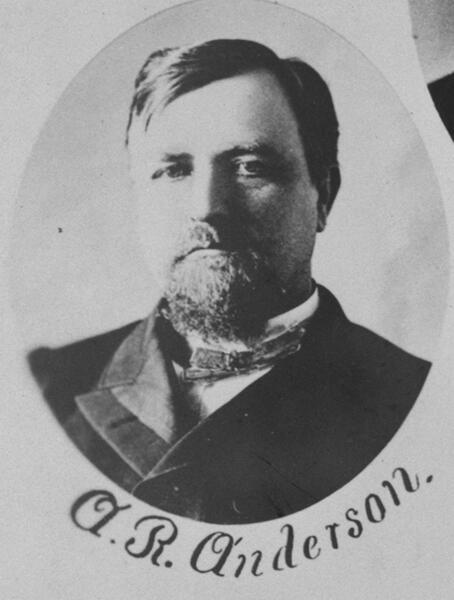
Albert Raney Anderson (November 8, 1837 – November 17, 1898) was a one-term U.S. Representative from Iowa’s 8th congressional district in southwestern Iowa. A member of the Independent Party in his successful congressional race, and often described as an “Independent Republican,” he is best known for winning election to Congress from Iowa and defeating a well-known incumbent without winning his own party’s endorsement. Anderson served as a Representative from Iowa in the United States Congress from March 4, 1887, to March 3, 1889, during a significant period in American history, contributing to the legislative process during his single term in office and participating in the democratic process on behalf of his constituents.
Anderson was born in Adams County, Ohio, on November 8, 1837. During his youth he moved with his parents to Galesburg, Illinois, where he attended the common schools and pursued further studies at Knox College in Galesburg. In 1857 he moved west to Taylor County, Iowa, where he began the study of law. He was admitted to the bar in 1860 and commenced the practice of law in Clarinda, Iowa, marking the beginning of a long professional career in the legal field that would underpin his later public service.
Shortly after establishing his law practice, Anderson entered federal service when President Abraham Lincoln appointed him postmaster of Clarinda in 1861. He resigned that position to enlist in the Union Army during the Civil War as a private in Company K, 4th Iowa Volunteer Infantry Regiment. Demonstrating notable bravery and leadership, he was commissioned first lieutenant for gallant service at the Battle of Pea Ridge. He subsequently became a captain during the Siege of Vicksburg and later served as assistant adjutant general during the Atlanta campaign. Over the course of the war he was promoted through the ranks to become major of his regiment and was commissioned lieutenant colonel in 1865. Anderson was mustered out of the service in August 1865 and returned to Clarinda, Iowa, resuming civilian life after four years of active military duty.
In 1866 Anderson moved to Sidney, Iowa, where he resumed the practice of law and soon entered local and federal administrative service. He served as assessor of internal revenue from 1868 to 1871, administering federal tax laws in his region during the Reconstruction era. A committed Republican at that time, he was a delegate to the Republican National Convention in Philadelphia in 1872. Anderson continued to build his legal and political reputation, serving as district attorney from 1876 to 1880. He then held statewide office as a member of the Iowa Board of Railroad Commissioners, serving a single term as state railroad commissioner beginning in 1881, an experience that would later shape his strong views on railroad regulation.
Anderson first sought a seat in Congress in 1882, when he was the Republican Party’s nominee for election to the Forty-eighth Congress from Iowa’s 9th congressional district. In that race he was defeated by Democrat William Henry Mills Pusey. Two years later, in 1884, Anderson was not the Republican nominee, but he was credited with engineering the nomination of “dark horse” candidate Joseph Lyman, who then defeated Pusey in the general election. In April 1886, Fremont County, where Anderson resided, was added to Iowa’s 8th congressional district, which Republican William Peters Hepburn had represented since 1881. Anderson immediately challenged Hepburn for the seat. When the Republican district convention endorsed Hepburn, Anderson refused to accept the decision and ran in the general election as an “Independent Republican.” While he remained a Republican in general political alignment, he campaigned vigorously on a platform calling for stricter regulation of the railroads and for the use of tariffs for revenue only. These positions resonated with voters and earned him the joint endorsement of the Democratic and Greenback parties. Running as an Independent Party candidate, he won the general election decisively by 2,225 votes, an upset that alarmed many of Hepburn’s colleagues in the House, who feared similar defeats if they did not respond to public demands for stronger federal railroad regulation.
During his term in the Fiftieth Congress, from March 4, 1887, to March 3, 1889, Anderson represented Iowa’s 8th congressional district and took part in the legislative deliberations of a period marked by growing concern over corporate power and economic regulation. Although he had been elected as an Independent Republican, he maintained complex political alignments in the House. He sat with the Republicans but voted with the Democratic caucus for John G. Carlisle as its choice for Speaker of the House, reflecting his independent stance and issue-based approach. One of the last votes he cast in Congress was on the Enabling Act of 1889, which set in motion the admission into the Union of North Dakota, South Dakota, Montana, and Washington, thereby helping shape the future map of the United States. In the 1888 election, Anderson sought reelection but was defeated by James Patton Flick, who had secured the Republican endorsement for the seat. Hepburn, his earlier rival, waited several years before attempting to regain the district, while Anderson’s single term remained notable for its challenge to party orthodoxy and its emphasis on railroad regulation.
After leaving Congress in 1889, Anderson continued his legal and public service career in the rapidly developing northern Plains. In 1892 he moved to Hot Springs in Fall River County, South Dakota, where he resumed the practice of law. He quickly became a leading figure in local civic affairs. Anderson served as mayor of Hot Springs in 1895 and 1896, applying his experience in law and government to municipal administration. On November 8, 1898, his sixty-first birthday, he was elected state attorney of Fall River County, further extending his record of public service at the county level in his adopted state.
Albert Raney Anderson died in Hot Springs, South Dakota, on November 17, 1898, only days after his election as state attorney. He was interred in Sidney Cemetery in Sidney, Iowa, returning in death to the community where he had earlier practiced law and built much of his career. His life encompassed service as a Civil War officer, local and federal administrator, state railroad commissioner, and one-term U.S. Representative from Iowa, during which he represented his constituents’ interests and contributed to the legislative process at a time of significant political and economic change in the United States.
Congressional Record