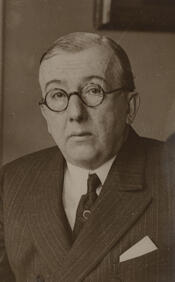
Alanson Bigelow Houghton (October 10, 1863 – September 15, 1941) was an American businessman, politician, and diplomat who served as a Congressman and Ambassador. A member of the Republican Party, he represented New York in the United States House of Representatives from 1919 to 1923 and later held prominent diplomatic posts. Over the course of his career he combined leadership in industry with public service during a significant period in American history.
Houghton was born on October 10, 1863, in Cambridge, Middlesex County, Massachusetts. He was the son of Ellen Ann (Bigelow) Houghton and Amory Houghton Jr. (1837–1909), who would later become president of Corning Glass Works, the glass manufacturing company founded by Alanson’s grandfather, Amory Houghton Sr., in 1851. In 1868, when Houghton was a young child, the family moved to Corning, Steuben County, New York, where the family enterprise was centered and where he spent much of his formative years.
Houghton received his early education at Corning Free Academy in Corning, New York, and later attended St. Paul’s School in Concord, New Hampshire, a prominent preparatory school. He went on to Harvard University, from which he graduated in 1886. Seeking further intellectual and cultural training, he pursued postgraduate studies in Europe, attending graduate schools in Göttingen and Berlin in Germany, and in Paris, France, from 1886 until 1889. This period of study abroad broadened his outlook and prepared him for the international responsibilities he would later assume as a diplomat.
Upon his return to Corning in 1889, Houghton entered the family business, Corning Glass Works. He rose steadily through the company’s leadership, serving as vice president from 1902 to 1910 and as president from 1910 to 1918. Under his direction, Corning Glass Works expanded dramatically, tripling in size and becoming one of the largest producers of glass products in the United States. During his tenure, the company manufactured approximately 40 percent of the incandescent light bulbs and 75 percent of the railway signal glass used in the country, reflecting both the scale of its operations and its importance to American industrial development. His interest in and promotion of education, particularly in western New York State, led to his appointment as a trustee of Hobart College in 1917. He was also a member of the Jekyll Island Club, often known as “The Millionaires Club,” on Jekyll Island, Georgia, where he associated with leading financiers and industrialists such as J. P. Morgan and William Rockefeller.
Houghton’s success in business and his civic interests drew him into public life. A Republican, he was elected as a Representative from New York to the United States Congress and served two terms in the House of Representatives from 1919 to 1923. His service in Congress occurred during a significant period in American history, in the aftermath of World War I and during the early 1920s, when the nation was adjusting to postwar economic and political conditions. As a member of the House of Representatives, Alanson Bigelow Houghton participated in the democratic process, contributed to the legislative work of the body, and represented the interests of his New York constituents in national affairs.
After his congressional service, Houghton continued his public career in diplomacy, drawing on both his international education and his experience in industry and government. He served as an American Ambassador, representing the United States abroad and participating in the conduct of foreign relations during a time of shifting global dynamics in the interwar period. His combined roles as businessman, legislator, and diplomat made him a notable figure in early twentieth-century American public life.
Alanson Bigelow Houghton died on September 15, 1941. By the time of his death, he had left a record of leadership in American manufacturing, a period of service in the United States Congress from 1919 to 1923, and subsequent diplomatic service as an ambassador, reflecting a career that bridged private enterprise and national service.
Congressional Record