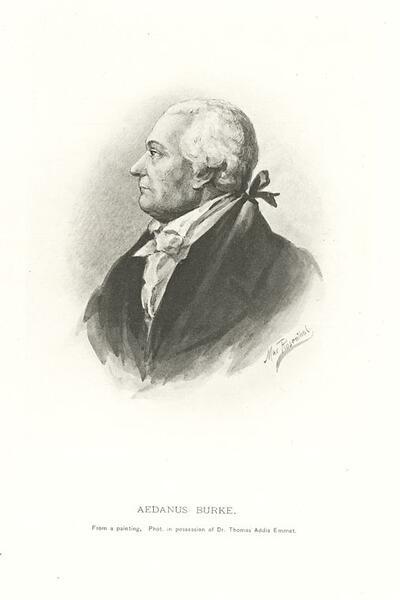
Aedanus Burke (June 16, 1743 – March 30, 1802) was a soldier, slaveholder, judge, and United States Representative from South Carolina. Born in Tiaquin, County Galway, in the Kingdom of Ireland, he was educated at the theological College of Saint Omer, a Roman Catholic institution on the Continent that served many Irish students barred from higher education at home. As a young man he traveled extensively, visiting New Orleans and the West Indies before returning to the American colonies. He ultimately settled in Charles Town, South Carolina (now Charleston), where he established himself in the legal profession and entered public life in the years leading up to the American Revolution.
Burke’s early public career was closely tied to the Revolutionary cause in South Carolina. He served in the militia forces of the state during the American Revolutionary War and, as the conflict intensified, emerged as a figure in both military and civil affairs. In 1778 he was appointed a judge of the South Carolina state circuit court, a position he held until British and Loyalist forces overran much of the state and disrupted the operation of the courts. During this same period he was elected to the South Carolina House of Representatives, serving from 1778 to 1779. When the military situation again demanded active service, he returned to the Revolutionary Army and served from 1780 to 1782, participating in the defense and eventual recovery of South Carolina from British control.
With the restoration of civil government after the war, Burke resumed his judicial duties when the courts were reestablished. In 1783 he also entered the realm of political pamphleteering under the pseudonym “Cassius.” That year he published two widely noted pamphlets, An Address to the Freemen of South Carolina (January 1783) and Considerations on the Society or Order of Cincinnati (October 1783). In the latter, he sharply criticized the newly formed Society of the Cincinnati, arguing that its hereditary membership provisions threatened to create a quasi-noble order in the fledgling republic and were incompatible with republican equality. His writings contributed to a broader national debate over the place of hereditary honors in the United States and enhanced his reputation as a vigilant critic of perceived aristocratic tendencies.
Burke’s legal and legislative responsibilities expanded in the mid-1780s. In 1785 he was appointed one of three commissioners charged with preparing a digest of the laws of South Carolina, an important effort to organize and clarify the state’s legal code in the aftermath of the Revolution. He also took part in the critical constitutional debates of the era. In 1788 he served as a member of the South Carolina convention called to consider ratification of the Constitution of the United States. In that convention he opposed ratification, aligning himself with those who feared that the proposed federal government would concentrate excessive power at the national level and threaten the rights of the states and the liberties of citizens.
Despite his opposition to the Constitution’s ratification, Burke later served in the new federal government. As a member of the Unknown Party representing South Carolina, he was elected as an Anti-Administration candidate to the First United States Congress and served one term from March 4, 1789, to March 3, 1791. His service in Congress occurred during a significant period in American history, as the new constitutional system was being implemented and foundational policies were debated. Burke contributed to the legislative process and represented the interests of his South Carolina constituents in these early national deliberations. He attracted national attention in March 1790 for a speech on the floor of the House of Representatives in which he derided Secretary of the Treasury Alexander Hamilton. Seizing on a remark Hamilton had made in a eulogy for General Nathanael Greene, where Hamilton had referred to some state militias during the Revolution as the “mimicry of soldiership,” Burke attacked Hamilton’s personal honor and criticized what he saw as disparagement of militia service. Hamilton responded that his comment had been taken out of context, and Burke later retracted his statement.
Burke declined to be a candidate for reelection to the Second Congress in 1790. His decision was influenced by a South Carolina statute prohibiting a state judge from leaving the state, a restriction that made continued service in the national legislature incompatible with his judicial responsibilities. Remaining in South Carolina, he continued to rise within the state’s judiciary. From 1796 to 1799 he served as the senior member of the South Carolina appellate courts, during which time he functioned as Chief Justice of South Carolina. In 1799 he was elected a chancellor of the courts of equity, a high judicial office in the state’s separate equity system, and he held this position until his death.
Aedanus Burke died in Charleston, South Carolina, on March 30, 1802. At the time of his death he was still serving as a chancellor of the courts of equity and remained a prominent figure in the state’s legal and political life. He was interred in the cemetery of the Chapel of Ease of St. Bartholomew’s Parish near Jacksonboro, South Carolina. Throughout his career, as a soldier, slaveholder, legislator, pamphleteer, and judge, Burke played a notable role in the political and judicial development of South Carolina and in the formative years of the United States under the Constitution he had once opposed.
Congressional Record