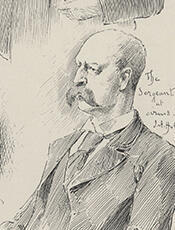
Adoniram Judson Holmes (March 2, 1842 – January 21, 1902) was an American lawyer, Civil War veteran, and Republican politician who became the first U.S. Representative from Iowa’s 10th congressional district. He served in the United States House of Representatives from 1883 to 1889, completing three consecutive terms and representing his largely rural northwestern Iowa constituency during a period of significant national growth and political realignment in the post–Civil War era.
Holmes was born on March 2, 1842, in Wooster, Wayne County, Ohio. He spent his early years in Ohio, where he received his initial education in local schools. As a young man, he moved west to the growing state of Iowa, part of a broader mid-19th-century migration that helped populate and develop the American Midwest. His early life coincided with the rising tensions that led to the Civil War, and his formative years were shaped by the political and social upheavals of that period.
With the outbreak of the Civil War, Holmes entered military service in the Union Army. He enlisted as a private and served in an Iowa regiment, participating in the Union war effort that preserved the nation and ended slavery. During his service he rose through the ranks, gaining leadership experience and a reputation for diligence and reliability. The discipline and public spirit he demonstrated in uniform would later inform his approach to public office and legislative work.
After the war, Holmes returned to Iowa and pursued legal studies, gaining admission to the bar and beginning the practice of law. He established himself professionally in the state, building a legal career that brought him into contact with local business interests, farmers, and community leaders. His work as an attorney, combined with his Civil War record, helped him gain prominence in Republican Party circles at a time when the party was dominant in Iowa politics. He became active in local and state affairs, aligning himself with the Republican emphasis on Union loyalty, economic development, and support for veterans.
Holmes’s growing stature in public life led to his election to the United States House of Representatives as a Republican. When Iowa was apportioned a new congressional district following population growth, he was chosen as the first U.S. Representative from Iowa’s 10th congressional district. He entered Congress on March 4, 1883, and served three consecutive terms, remaining in office until March 3, 1889. During these years he participated in the legislative process in the Forty-eighth, Forty-ninth, and Fiftieth Congresses, representing the interests of his constituents in a region heavily dependent on agriculture and emerging rail connections. As a member of the House of Representatives, Holmes contributed to debates and votes on issues central to the late nineteenth century, including economic policy, veterans’ affairs, and the continued development of the American West.
Holmes’s congressional service occurred during a significant period in American history, marked by industrial expansion, the consolidation of the railroad network, and ongoing efforts to integrate western territories more fully into the national economy. Within this context, he worked to ensure that the concerns of his Iowa district—particularly those of farmers, small-town merchants, and veterans—were heard in Washington. As a Republican, he generally supported the party’s national program of protective tariffs and internal improvements, and he remained closely identified with the Unionist and reform traditions that had shaped his early political identity.
After leaving Congress in 1889, Holmes returned to Iowa and resumed his legal and civic activities. He remained a respected figure in state Republican circles and in his local community, drawing on his experience in national office and his longstanding ties to veterans and agricultural interests. He continued to live in Iowa until his death on January 21, 1902. Adoniram Judson Holmes was buried in Iowa, and his career is remembered for his role as the inaugural representative of Iowa’s 10th congressional district and for his three-term service in the House of Representatives during a transformative era in American political and economic life.
Congressional Record