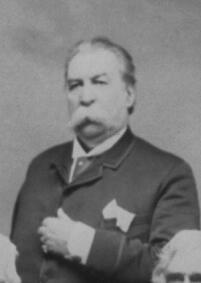
Abram Wakeman (May 31, 1824 – June 29, 1889) was an attorney, businessman, and politician from New York City. An important figure in the creation of the Republican Party in the mid-1850s and a steadfast supporter of the Union during the American Civil War, he was most notable for his service as a U.S. Representative from New York from 1855 to 1857. Over the course of a varied public career, he combined legal practice, business ventures, and political activity at the local, state, and national levels.
Wakeman was a native of Greenfield Hill, Connecticut, where he was born on May 31, 1824. He completed a college preparatory education in his youth, reflecting the emphasis his family placed on formal learning. As a young man he taught school while studying law, a common path for aspiring attorneys of his generation who needed to support themselves while reading law in established offices. His legal studies culminated in his admission to the bar in 1847, after which he moved to New York City to begin his professional career.
Upon his admission to the bar, Wakeman established a law practice in New York City. In addition to his legal work, he became involved in several business enterprises, including banks, railroads, and insurance companies, interests that were closely tied to the city’s rapid commercial expansion in the mid-nineteenth century. His engagement with these sectors gave him experience in finance and transportation that would later inform his public service, particularly in positions connected with the federal government’s revenue and postal systems.
Wakeman’s political career began in the Whig Party, where he became a colleague and ally of prominent New York leaders William H. Seward and Thurlow Weed. He was elected to the New York State Assembly, serving from 1850 to 1852, and subsequently held municipal office as a New York City alderman from 1854 to 1856. During this period he gained a reputation as an active participant in local and state politics. As the Whig Party fractured in the early 1850s, he was associated with the emerging anti-slavery and reform elements that would soon coalesce into the Republican Party.
In 1854, Wakeman was elected as a Representative from New York to the United States Congress. Identified at the time with the Independent Party during the realignment of national politics, he served one term in the House of Representatives from 1855 to 1857. His service in Congress occurred during a significant period in American history marked by sectional conflict over slavery and the future of the Union. As a member of the House, Wakeman participated in the legislative process and represented the interests of his New York constituents while national debates over issues such as the Kansas–Nebraska Act and the expansion of slavery dominated congressional deliberations. In 1855 he helped found the Republican Party, reflecting his shift from Whig and Independent affiliations into the new political organization, and in 1856 he served as a delegate to the first Republican National Convention, which nominated John C. Frémont for president.
During the American Civil War, Wakeman was a strong supporter of the Union and of President Abraham Lincoln’s administration. Drawing on his political connections and business experience, he provided important organizational and financial aid to the Union cause, contributing to efforts to sustain public support and logistical capacity in New York, a critical state for the war effort. His loyalty and service to the administration were recognized with significant federal appointments. From 1862 to 1864 he served as Postmaster of New York City, overseeing one of the nation’s most important postal districts at a time when reliable communication was essential to both civilian and military affairs. From 1864 to 1869 he held the post of Surveyor of the Port of New York, a lucrative and influential customs position central to the collection of federal revenues at the country’s busiest port.
In his later years, after leaving federal office, Wakeman continued his business pursuits and became one of the early developers of Coney Island as a resort and amusement destination. He invested in and helped promote the area’s transformation from a relatively undeveloped coastal tract into a popular leisure site for New Yorkers and visitors. His role in these ventures proved financially successful, and he realized a substantial profit when he sold his interests to a syndicate of investors as Coney Island’s commercial potential expanded.
Abram Wakeman died in New York City on June 29, 1889. He was buried at Green-Wood Cemetery in Brooklyn, New York, a resting place for many of the city’s nineteenth-century political and business leaders. His career, spanning law, commerce, and politics, reflected the dynamic and often turbulent public life of the United States in the decades leading up to and following the Civil War, and his contributions to the formation of the Republican Party and to the Union cause marked his most enduring public legacy.
Congressional Record