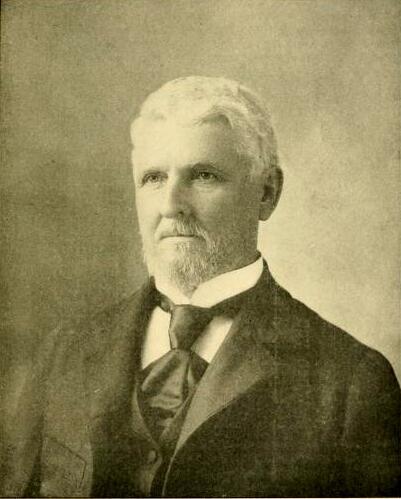
Abram Fulkerson (May 13, 1834 – December 17, 1902) was a Confederate officer during the American Civil War and a Virginia lawyer and politician who helped form the short-lived Virginia Readjuster Party. He served in both houses of the Virginia General Assembly, as well as in the U.S. House of Representatives, after which he published accounts of his wartime exploits and captivity. His life and career reflected the military traditions of his family, the upheavals of the Civil War, and the political realignments of postwar Virginia.
Fulkerson was born on May 13, 1834, in Washington County, Virginia, the youngest son of Abram Fulkerson Sr. (1789–1859) of Lee County, Virginia, and his wife, Margaret Laughlin Vance (1796–1864). The family took pride in a strong military heritage. His grandfather, James Fulkerson, served as a captain in the Virginia militia during the American Revolution, joining the Overmountain Men and fighting the British at the Battle of Kings Mountain. His father, Abram Fulkerson Sr., served during the War of 1812 as a captain of a Virginia militia company in Colonel David Sanders’ Regiment, 4th Brigade, Norfolk Division, under General Peter B. Porter. By 1850 the elder Fulkerson had moved to Grainger County, Tennessee, where his eldest son James L. Fulkerson died, but he returned to Washington County, Virginia, before his own death in 1859. The family included several sons who survived to adulthood—James Lyon Fulkerson (1816–1849), Samuel Vance Fulkerson (1822–1862), Francis Marion Fulkerson (1825–1894), and Isaac Fulkerson (1831–1889)—as well as daughters Mary Vance Fulkerson Davis (1820–1892), Harriet Jane Fulkerson Armstrong (1827–1911), and Katherine Elizabeth Fulkerson (1832–1903). His brother Samuel Vance Fulkerson served in the Mexican–American War and later as a delegate to the Virginia Constitutional Convention of 1850, further reinforcing the family’s public and military profile.
Abram Fulkerson graduated from the Virginia Military Institute (VMI) at Lexington in 1857. While at VMI he studied under Professor Thomas Jonathan “Stonewall” Jackson, as had his elder brother Samuel before him. VMI records also note that another brother, Isaac, was remembered as a prankster who wore an “outlandish collar” on his cadet uniform, exploiting the fact that the collar was the only part of the uniform not covered by regulations. After graduation, Abram taught school in Palmyra, Virginia, and by 1860 was teaching in Rogersville, Hawkins County, Tennessee. On January 28, 1862, during the Civil War, he received a furlough and went to Clarksville, Tennessee, where he married his fiancée, Selina Johnson (1832–1918). The couple left Clarksville just ahead of the advancing Union Army. The war took a heavy toll on his family: in June 1862 his brother, Colonel Samuel Vance Fulkerson, was killed in action while leading the 37th Virginia Infantry at the Battle of Gaines’ Mill, and another brother, Isaac, served as a captain in the 8th Texas Cavalry (Terry’s Texas Rangers).
Fulkerson entered Confederate military service in June 1861 as a captain, having organized a company of men from Hawkins County, Tennessee, that was mustered into the 19th Tennessee Infantry Regiment as Company K (“The Hawkins Boys”) at Knoxville, Tennessee. His was the first company of volunteers organized in East Tennessee, and he soon received a commission as the regiment’s major. He fought at the Battle of Shiloh, where he was wounded in the thigh and had his horse shot from under him. After his recovery and the reorganization of the unit, he was reassigned to the 63rd Tennessee Infantry and commissioned lieutenant colonel; on February 12, 1864, President Jefferson Davis commissioned him as a full colonel. Fulkerson twice helped garrison the strategic Cumberland Gap, first with the 19th Tennessee and later with the 63rd Tennessee. From Cumberland Gap on May 18, 1863, he wrote to his wife describing a brief visit by President Davis and reflecting on the recent death of his former instructor, General Stonewall Jackson, whose loss he called a “national calamity” and whose character he praised as “spotless.”
Serving with the 63rd Tennessee, Fulkerson was wounded twice more: in the left arm at the Battle of Chickamauga and again at the Second Battle of Petersburg (Petersburg II), after the regiment had been transferred from the Army of Tennessee to the Army of Northern Virginia. He was captured on June 17, 1864, when Union forces overran his position near Petersburg, and he was sent to the prisoner-of-war camp at Fort Delaware. In an account written on April 18, 1892, he described his capture and an acrimonious exchange with Union General Ambrose Burnside, who expressed surprise that a Tennessean would be fighting for the Confederacy and cited prominent East Tennessee Unionists such as Andrew Johnson and William G. Brownlow; Fulkerson replied that “the respectable people are on our side,” provoking a sharp rebuke from Burnside. While a prisoner, Fulkerson became one of the “Immortal Six Hundred,” a group of Confederate officers transferred to Morris Island at Charleston, South Carolina, and used as human shields in an attempt to deter Confederate artillery fire from Fort Sumter, in retaliation for Confederate placement of Union officers under fire near Charleston. He later recounted the harsh regulations imposed on the prisoners, including a “dead line” near the stockade wall, restrictions on gatherings of more than ten men, and orders allowing sentries to fire into tents if lights were struck after taps. He described the fear inspired by the artillery duels between Union batteries and Confederate forts around Charleston Harbor, noting that although shells passed close over their stockade, none fell within it and no prisoners were killed by Confederate fire.
After about six weeks on Morris Island, Fulkerson and the other officers were transferred to Fort Pulaski, located on an island at the mouth of the Savannah River. There they were subjected to “retaliation rations” for 42 days, in response to reported abuses of Union prisoners at Andersonville. Confined in cold, damp casemates, they received only 10 ounces of moldy cornmeal and a half pint of soured onion pickles per day, and many supplemented their diet with rats or stray cats. Thirteen prisoners died of preventable diseases such as dysentery and scurvy. On December 13, 1864, the prisoners organized “The Relief Association of Fort Pulaski for Aid and Relief of the Sick and Less Fortunate Prisoners,” and Fulkerson was elected president; by his report of December 28, 1864, the association had collected and disbursed eleven dollars from their scant resources to assist the neediest inmates. In March 1865 he was returned to Fort Delaware, where he remained until he was discharged and paroled on July 25, 1865, months after General Robert E. Lee’s surrender at Appomattox. Fellow prisoners recalled that at Fort Delaware, where inmates were allowed to bathe and swim daily in the polluted river, the very thin, auburn-haired Fulkerson could float “like a cork” and would drift out with the current until nervous guards ordered him back to shore.
Following his parole, Fulkerson returned to civilian life in southwest Virginia. His wartime horse, officially named “Zollicoffer” after former Congressman and early Confederate casualty Felix Zollicoffer, was returned to him; he kept the animal for the rest of its life, calling it “Old Bob.” When the horse died, former Confederates from the Bristol area assembled and conducted a military funeral for it. In 1885, when Stonewall Jackson’s famous horse “Little Sorrel” was brought to Bristol on tour, Fulkerson rode the animal as local veterans gathered to pay their respects. As the war ended, he studied law, was admitted to the bar, and in 1866 began his legal practice in Goodson—later known as Bristol—Virginia, in the firm of York & Fulkerson. He quickly gained a reputation as a leading attorney in the region and was regarded as a legal giant in Bristol; contemporaries recalled that he was such a gifted orator that local citizens would attend court proceedings simply to hear him speak.
Fulkerson entered public office during the turbulent Reconstruction and post-Reconstruction era. He was elected and re-elected to the Virginia House of Delegates as one of two part-time delegates representing Washington County, serving from 1871 to 1875, when voters replaced both delegates. He then served in the Senate of Virginia from 1877 to 1881. During this period he became a key figure in the formation of the Readjuster Party, a biracial coalition that sought to “readjust” Virginia’s prewar public debt in order to reduce the tax burden and redirect funds toward public education and other services. Identifying as a Readjuster Democrat, he helped organize the party and participated in its efforts to challenge the Conservative Democratic establishment in the state.
Voters from Virginia’s 9th congressional district elected Fulkerson as a Readjuster Democrat to the Forty-seventh Congress, where he served one term from March 4, 1881, to March 3, 1883. He defeated incumbent James Buchanan Richmond, a lawyer and banker who had previously served as a subordinate officer under his brother Samuel in the 37th Virginia Infantry, in the Democratic primary. As a member of the Readjuster Democrat Party representing Virginia, Fulkerson contributed to the legislative process during this term in office, participating in the democratic process at a significant period in American history and representing the interests of his constituents from southwest Virginia. His service in Congress coincided with national debates over civil service reform, federal spending, and the lingering issues of Reconstruction. After his term, he returned to the Democratic Party as the Readjuster movement waned. He chose not to seek re-election, and fellow Readjuster Henry Bowen succeeded him in the House of Representatives.
After leaving Congress, Fulkerson resumed his legal practice in Bristol. He remained active in state politics, and voters again elected him to the Virginia House of Delegates in 1888, alongside John A. Buchanan; together they replaced Daniel Trigg and Jonas S. Kelly and were in turn replaced in 1887 by John Roberts and S. P. Edmonson, reflecting the fluid political alignments of the era. In his later years he turned increasingly to writing and commemoration of the war. He wrote a detailed memoir of his captivity, based in part on the 1892 account of his imprisonment at Fort Delaware, Morris Island, and Fort Pulaski, and published it in 1894. He also remained engaged in national Democratic politics and served as a delegate to the Democratic National (Gold) Convention in 1896, aligning with the faction that supported the gold standard during the party’s internal monetary-policy disputes.
Fulkerson died in Bristol, Virginia, on December 17, 1902, at the age of 68, from complications following a stroke. At his funeral, Henry Clinton Wood—who had served as major of the 37th Virginia Infantry under Fulkerson’s brother Samuel Vance, and for whom the town of Clintwood, Virginia, was named—served as an honorary pallbearer. His widow, Selina Johnson Fulkerson, survived him by more than a decade, dying in 1918. Their son, Samuel Vance Fulkerson (1863–1926), married in Grayson, Texas, but returned to Virginia, became a lawyer, and died at Virginia Beach on July 2, 1926; he was buried with his parents in East Hill Cemetery. The Virginia Military Institute preserves the Fulkerson family papers in its archives, documenting the family’s military and political history. His memory is also honored by the Sons of Confederate Veterans Abram Fulkerson Camp 2104 in Greeley, Colorado. A descendant and third cousin, Joe Adkins, portrays Abram Fulkerson at Civil War reenactments and commands the Gen. Alfred E. Jackson Camp 2159 of the Sons of Confederate Veterans in Jonesborough, Tennessee, continuing the family’s association with Civil War commemoration.
Congressional Record