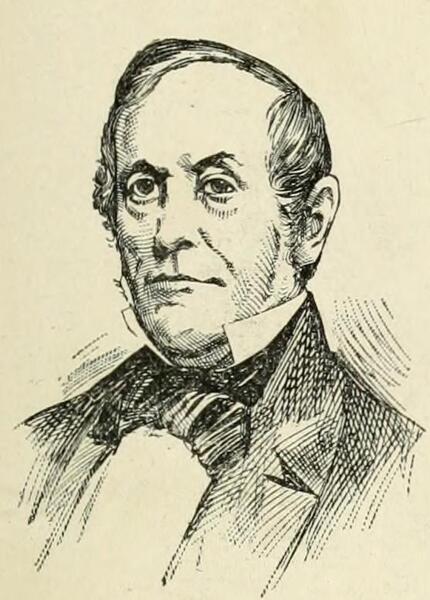
Abraham Rencher (August 12, 1798 – July 6, 1883) was a politician from the state of North Carolina whose public career included service as a United States Congressman, United States Chargé d’Affaires to Portugal, and Governor of New Mexico Territory. He was born near Raleigh, North Carolina, on August 12, 1798, to John Grant Rencher, the county sheriff, and Ann (Nelson) Rencher. Tutored at home in his early years, he later attended local common schools and Pittsboro Academy, reflecting the educational opportunities available in the early republic. Rencher pursued higher education at the University of North Carolina at Chapel Hill, from which he graduated in 1822. He then studied law under Frederick Nash, a prominent North Carolina jurist, and was admitted to the bar in 1825, commencing legal practice in Pittsboro, North Carolina.
Rencher’s legal career in Pittsboro provided the foundation for his entry into politics at a time of intense partisan realignment in the United States. He first won election to the United States House of Representatives as a Jacksonian, serving in the Twenty-first and Twenty-second Congresses. As national politics fractured over the policies of President Andrew Jackson, Rencher’s own affiliations evolved. He was reelected as an Anti-Jacksonian to the Twenty-third and Twenty-fourth Congresses and then as a Whig to the Twenty-fifth Congress, serving continuously from March 4, 1829, to March 3, 1839. During these six consecutive terms, he represented North Carolina in the House of Representatives and contributed to the legislative process during a significant period in American history, participating in the democratic process and representing the interests of his constituents amid debates over banking, internal improvements, and the balance of federal and state authority. He declined to be a candidate for renomination in 1838, stepping back from Congress after a decade of service.
After a brief interval out of office, Rencher returned to national politics when he was again elected to Congress as a Whig in 1840. He served one additional term in the Twenty-seventh Congress, from March 4, 1841, to March 3, 1843. His final term in the House coincided with the tumultuous early 1840s, marked by economic recovery efforts following the Panic of 1837 and continued disputes over federal economic policy. Citing ill health, Rencher declined to be a candidate for renomination in 1842, thereby concluding his legislative career in the national legislature after a total of seven terms.
Rencher’s experience in Congress and his alignment with the Whig Party’s national leadership led to his appointment to diplomatic service. In 1843 President John Tyler appointed him United States Chargé d’Affaires to Portugal, a post he held until 1847. In this capacity, Rencher represented American interests in Lisbon during a period when the United States was expanding its commercial and maritime presence abroad. His service in Portugal added international diplomatic experience to a résumé already marked by long legislative tenure.
In 1857 Rencher returned to federal service in a territorial executive role. President James Buchanan, with whom Rencher was politically allied, initially suggested him for the post of Secretary of the Navy, but Rencher declined that cabinet-level opportunity and instead lobbied for the governorship of New Mexico Territory. He was appointed Governor of New Mexico Territory on August 17, 1857, and arrived in Santa Fe on November 11 of that year. He served as governor from August 17, 1857, to May 24, 1861, a period of mounting sectional tension and frontier conflict. As governor, Rencher frequently clashed with the military authorities in the territory and was critical of their campaigns against Native American groups. His administration was notable for securing legislation requiring that all children in the territory attend school, an early territorial effort to promote public education. He also worked to reduce the territory’s public debt and was credited with significantly lowering it during his tenure. A slaveholder, Rencher in 1859 signed legislation defining and protecting the status of enslaved people as property in the territory, aligning New Mexico’s legal framework with pro-slavery interests on the eve of the Civil War. Nonetheless, when the Civil War began, he remained loyal to the Union and raised regiments to defend the territory. President Abraham Lincoln chose not to reappoint him, and Rencher left office in August 1861, marking the end of his formal territorial administration.
Following his departure from New Mexico, Rencher returned to his home in Pittsboro, North Carolina, where he lived in retirement. Although a slaveholder and a Democrat by the late 1850s, he maintained his support for the Union and took no active part in the Civil War once he had returned to North Carolina. His later years were spent largely out of public life, reflecting a withdrawal from the increasingly polarized and war-torn national political scene.
In his personal life, Rencher married Louisa Mary Jones in 1836. She was the daughter of Colonel Edward Jones and Elizabeth Mallett Jones, members of a prominent North Carolina family. The couple had four children, and their household in Pittsboro reflected the social and political standing Rencher had attained through his long public career. Abraham Rencher died in Chapel Hill, North Carolina, on July 6, 1883. He was interred at St. Bartholomew’s Protestant Episcopal Churchyard in Pittsboro, North Carolina, closing a life that spanned from the early national period through Reconstruction and that encompassed service in Congress, diplomacy, and territorial governance.
Congressional Record