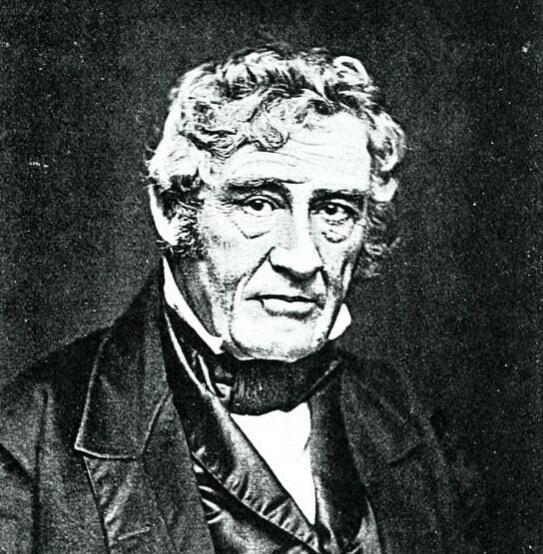
Abner Hazeltine (June 10, 1793 – December 20, 1879) was an American attorney, legislator, and judge from New York whose public career spanned six decades and included service in the New York State Assembly, the United States House of Representatives, and multiple judicial and prosecutorial offices in Chautauqua County. After attaining admission to the bar in 1819, he practiced law for approximately 60 years, remaining professionally active in Jamestown, New York, until his death at the age of 86.
Hazeltine was born in Wardsboro, Windham County, Vermont, on June 10, 1793, the son of Daniel Hazeltine and Susannah (Jones) Hazeltine. He attended the common schools of Wardsboro and received additional instruction from the pastor of his church, who served as his tutor. Demonstrating early academic promise, he entered Williams College in Williamstown, Massachusetts, and graduated in 1815. Shortly after his graduation, he moved to Jamestown, in Chautauqua County, New York, then a developing community in the western part of the state.
Upon his arrival in Jamestown in 1815, Hazeltine became a teacher and was one of the founders of Jamestown Academy, where he taught for several years. At the same time, he pursued legal studies in the offices of local attorneys Jacob Houghton and Samuel A. Brown. He was admitted to the bar in 1819 and commenced the practice of law in Jamestown. Soon thereafter he moved to Warren, Pennsylvania, where he became the first lawyer in Warren County. Hazeltine remained there until 1823, when he returned to Jamestown and resumed his legal practice. In addition to his law work, he served as an editorial writer for the Jamestown Journal from 1826 to 1829 and became involved in local business affairs, including service as a director of the Chautauqua County Bank. In the mid-1820s he joined other Chautauqua County residents in advocating for the construction of a canal to connect the Erie Canal with the Allegheny River, a project intended to create a continuous transportation route to Pittsburgh and enhance regional commerce.
Hazeltine’s political and public career developed alongside his legal practice. He was elected to the New York State Assembly and served two terms, in 1829 and 1830. Initially aligned with the Anti-Masonic movement, he was elected to the Twenty-third Congress as an Anti-Masonic candidate and reelected to the Twenty-fourth Congress as an Anti-Jacksonian, serving from March 4, 1833, to March 3, 1837. He did not seek renomination in 1836. During his congressional service he was known as an advocate of temperance and served as a vice president of the Congressional Temperance Society. He was also a consistent opponent of slavery and resisted efforts in the House of Representatives to bar the reception of antislavery petitions, placing him among the early congressional voices critical of pro-slavery procedural restrictions.
After leaving Congress, Hazeltine continued to play a prominent role in public affairs in western New York. Over time he shifted his party affiliations in response to the evolving national debate over slavery, moving from the Anti-Masonic and Anti-Jacksonian positions into the Whig Party. He served as district attorney of Chautauqua County from 1847 to 1850, prosecuting criminal cases on behalf of the state. When the Republican Party emerged in the mid-1850s as the principal national anti-slavery party, Hazeltine became an early adherent. He was elected judge of the Chautauqua County Court and served from 1859 to 1863. During the American Civil War he was appointed a state commissioner responsible for overseeing the Union Army draft in Chautauqua County, a position that placed him at the center of local implementation of federal conscription policies.
In his later years Hazeltine continued to hold judicial and quasi-judicial posts while maintaining his law practice. He was appointed a special judge of the Chautauqua County Court in 1873 and served in that capacity until 1874. Also in 1873 he was appointed United States Commissioner for the courts of the Northern District of New York, a federal position in which he handled preliminary judicial matters such as affidavits, warrants, and examinations in federal cases. He held this commission from 1873 until his death, underscoring his long-standing reputation for legal competence and public trust.
Hazeltine married twice. In 1819 he wed Polly Kidder of his native Wardsboro, Vermont. She died in 1832. In 1834 he married Matilda Hayward. He was the father of four children with his first wife and three with his second. Of these children, Harriet worked as a store cashier in Jamestown, and Lydia died in infancy. Charles pursued a career as a teacher, and Marvin entered the clergy. Lewis became a physician, Abner Hazeltine Jr. followed his father into the legal profession as an attorney, and Mary married De Forest Weld, a merchant in Jamestown. Through his family, as well as his professional and civic activities, Hazeltine was closely connected to the social and economic life of Jamestown and Chautauqua County.
Abner Hazeltine died in Jamestown, New York, on December 20, 1879, while still active in the practice of law and in his role as United States Commissioner. He was interred at Lake View Cemetery in Jamestown. His long career as lawyer, legislator, judge, and civic leader made him a significant figure in the legal and political history of western New York in the nineteenth century.
Congressional Record