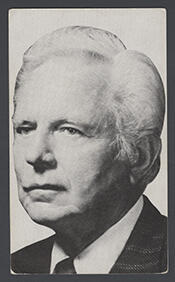
Aaron Harlan (September 8, 1802 – January 8, 1868) was a U.S. Representative from Ohio and a cousin of Andrew Jackson Harlan. He was born in Warren County, Ohio, where he attended public schools before pursuing legal studies at a law school. After completing his legal education, he was admitted to the bar and, in 1825, began the practice of law in Xenia, Greene County, Ohio. His early professional life was thus rooted in the legal profession, which provided the foundation for his subsequent career in public service and politics.
Harlan entered state politics in the early 1830s. He served as a member of the Ohio House of Representatives in 1832 and 1833, representing his constituency during a period of growth and political realignment in the state. He later advanced to the upper chamber of the state legislature, serving in the Ohio Senate in 1838 and 1839. In 1841 he moved to a farm near Yellow Springs, Ohio, where he continued to practice law while also engaging in agricultural pursuits, reflecting the dual professional and agrarian character common among mid-19th-century public figures in the region.
Harlan remained active in state and national politics throughout the 1840s and early 1850s. In the presidential election of 1844, he served as a Presidential elector on the Whig ticket for Henry Clay and Theodore Frelinghuysen, underscoring his alignment with Whig principles of the era. He returned to the Ohio Senate in 1849, further solidifying his role in state governance. In 1850 he served as a delegate to the Ohio state constitutional convention, participating in the revision of the state’s fundamental law. Two years later, in 1852, he became a member of the board of trustees of Antioch College in Yellow Springs, reflecting his interest in education and the development of one of Ohio’s notable institutions of higher learning.
Harlan’s national political career began with his election to the United States House of Representatives. He was elected as a Whig to the Thirty-third Congress and served from March 4, 1853. As party alignments shifted in the 1850s, he was reelected as an Opposition Party candidate to the Thirty-fourth Congress and then elected as a Republican to the Thirty-fifth Congress, serving continuously in the House from March 4, 1853, to March 4, 1859. His service thus spanned a critical period leading up to the Civil War, during which the Whig Party collapsed and the Republican Party emerged as a major national force.
After three consecutive terms in Congress, Harlan was an unsuccessful candidate for reelection in 1858 to the Thirty-sixth Congress. He sought to return to the House in 1861 as a candidate to fill a vacancy in the Thirty-seventh Congress but was again unsuccessful. Following these defeats, he resumed the practice of law and continued his agricultural pursuits near Yellow Springs, maintaining his professional and personal ties to the community where he had long resided.
During the Civil War period, Harlan also held a military-related position at the state level. In 1862 he served as lieutenant colonel of the Ninety-fourth Regiment of Minutemen of Ohio, a unit organized for the defense of the state during the conflict. This role reflected his continued engagement in public service and his support for the Union cause during a time of national crisis.
In 1864 Harlan moved west to San Francisco, California, where he resided for the remaining years of his life. He lived there until his death on January 8, 1868. Following his death, he was interred in Laurel Hill Cemetery in San Francisco, a prominent burial place in the city during that period.
Congressional Record